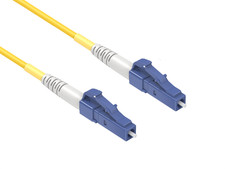
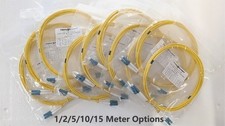
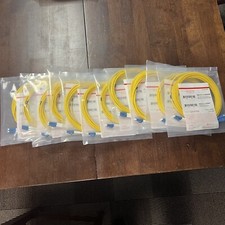
5m LC to LC Simplex Single Mode Fiber Patch Cable, OS2 9/125 Corning, LSZH/OFNR, Yellow
The CableLeader FB119-91XX is an OS2 simplex patch cable: one single mode fiber in one 2.0 mm jacket, terminated with a blue LC/UPC connector on each end. Simplex is the single-fiber counterpart to the common duplex zipcord — where duplex carries transmit and receive on separate strands, simplex carries one optical path, the correct construction for links that need exactly one fiber. The family spans 0.5 m through 30 m, reaching distances duplex stock cables rarely cover.
The defining use case is the offeri link. offerirectional transceivers transmit and receive on a single strand using different wavelengths, so each offeri SFP port takes one simplex LC connector rather than a duplex pair. Simplex cables also serve one-way signal paths such as monitoring taps and OTDR test ports, and they restore service when one half of an installed duplex pair is damaged or when a spare strand must be patched. Because each strand is independent, two simplex cables can substitute for a duplex pair when routing demands it.
Each LC/UPC connector uses a short boot 19.5 mm body whose 1.25 mm ferrule suits high-density panels. The UPC flat/domed polish is rated 55 dB minimum return loss, the standard for data links, and every connector is factory-tested to 0.30 dB maximum insertion loss at 1310/1550 nm. Blue housings mark UPC polish — this cable mates only with UPC ports, never with green APC receptacles.
The jacket is LSZH/OFNR rated under UL file E510298. Low-smoke zero-halogen material limits toxic emissions in enclosed equipment rooms, while the OFNR riser rating permits vertical runs between floors — relevant for a family whose 20 m and 30 m variants often cross floor boundaries. RoHS compliance covers restricted-substance procurement requirements.
The Corning G657A1 fiber grade is bend insensitive, tolerating tight routing radii in cable managers, vertical rings, and wall enclosures without the attenuation spikes standard G652D fiber shows under the same handling. It remains fully compatible with installed G652D single mode plant, so this cable drops into existing OS2 structured cabling, splice trays, and panels.
Compatibility & Ordering Information — FB119-91XX mates with LC/UPC (blue) single mode ports: offeri SFP transceivers, switches, media converters, monitoring taps, and UPC patch panels. Do not plug it into green APC ports. The family is offered from 0.5 m through 30 m; select the variant covering the run plus a service loop, and order two cables for a standard duplex transmit-receive link. For two-fiber links see the FB131-91XX duplex family; for an SC/APC simplex format see FB121-96XX.
Product Comparison: Simplex vs Duplex Single Mode Patch Cable
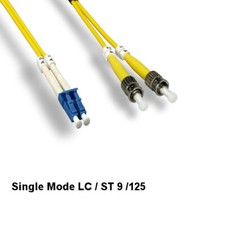
Both cables use identical Corning OS2 9/125 G657A1 fiber and blue LC/UPC connectors; the difference is the number of fibers, which must match how your equipment transmits and receives. The table summarizes the decision:
AttributeSimplex LC/UPC OS2 (this product)Duplex LC/UPC OS2ConstructionOne fiber, single 2.0 mm strand, one LC per endTwo fibers, 2.0 x 4.1 mm zipcord, LC pair per endTransmit / ReceiveBoth directions on one strand (offeri) or one-way signalTransmit on one strand, receive on the otherMatching Equipmentofferi SFP modules, monitoring taps, OTDR test portsStandard SFP transceivers, switches, media convertersLength Range0.5 m to 30 m in this family0.5 m to 50 m in the duplex familyFiberCorning OS2 9/125 G657A1 bend insensitiveCorning OS2 9/125 G657A1 (same grade)Best Forofferi links, single-fiber runs, spare-strand patchingStandard two-fiber data links
Select the simplex version (this product) when the link uses exactly one fiber — offeri transceivers, monitoring ports, or restoring one strand of an installed pair.
Select the duplex version when equipment transmits and receives on separate fibers, the standard case for switches and SFP modules. Both are blue LC/UPC and mate only with UPC ports — never with green APC.
FAQ
What is the difference between simplex and duplex fiber patch cables?
Simplex carries one fiber in one jacket; duplex carries two fibers in a zipcord pair. Standard transceivers transmit on one strand and receive on the other, so they need duplex, while offeri transceivers, monitoring taps, and one-way signal paths use exactly one strand — that is the simplex case. This cable is simplex: one 2.0 mm strand with one LC/UPC connector per end.
Is this cable compatible with offeri SFP transceivers?
Yes — offeri modules transmit and receive on a single fiber at different wavelengths, and each module takes one simplex LC connector. Connect one FB119 cable between the two offeri ports and the link is complete. Both ends are blue LC/UPC, the polish standard on transceivers; do not plug them into green APC ports.
What loss ratings does this cable carry?
Each LC/UPC connector is factory-tested to 0.30 dB maximum insertion loss at 1310/1550 nm and rated 55 dB minimum return loss, the UPC standard. The single Corning 9/125 um G657A1 strand is OS2 grade, so the cable serves 1310 nm and 1550 nm single mode links across the full 0.5 m to 30 m family range.
How do I connect a simplex LC cable correctly?
Align the LC latch with the port keyway and push straight in until it clicks; press the latch to release. On offeri links simply connect the one strand between the two modules. On one-way paths confirm which port transmits and which receives before patching, and leave a small service loop so the connector is never under tension.
Which fiber patch cable is best — simplex or duplex?
Choose simplex (this cable) when the link uses one fiber: offeri transceivers, monitoring or OTDR test ports, and spare-strand patching. Choose duplex (FB131 family) when equipment transmits and receives on separate fibers — the standard two-strand case for switches and SFP modules. Count the fibers your ports need; that decides.