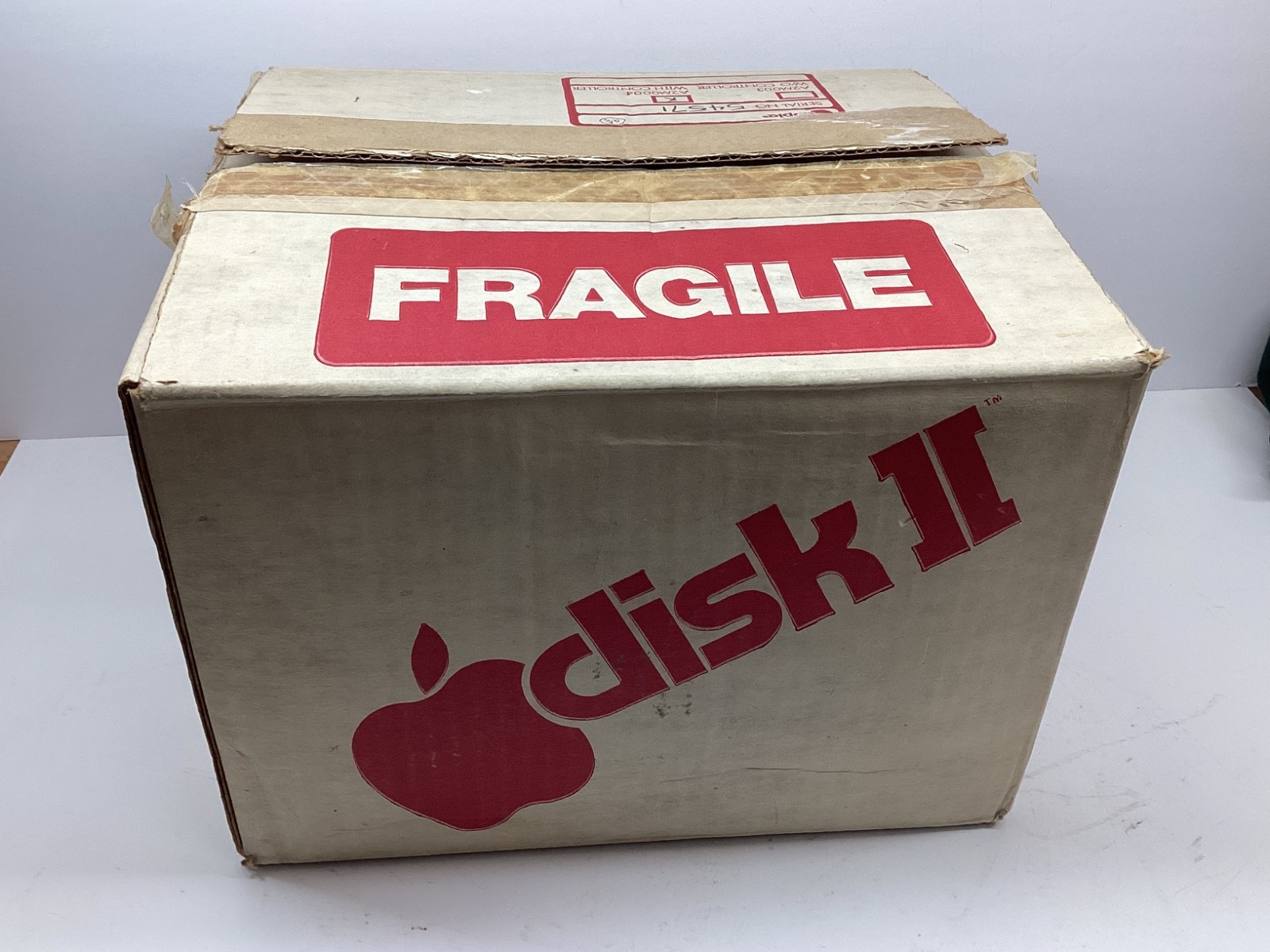
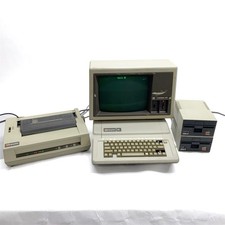
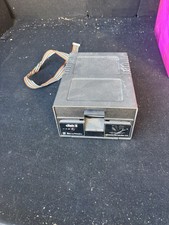
vintage Apple Disc II5.25-inch external floppy disk drive with original box
Industrial model in the scientist section of apple sales or for programmers and students includes a switch on the top leftlabeled with SAFE, NORMAL, and WRITE positions to control or override the floppy disk write-protect mechanism.
How the Switch WorksNORMAL: The drive behaves as originally designed by Apple, relying on the physical write-protect notch on the 5.25-inch disk jacket (or the lack thereof) to determine whether data can be written, this overrides all of that with the second position
WRITE (Override):This position bypasses the write-protect sensor entirely. In the era of vintage computing, users frequently used this modification to write to "flippy" disks (using the blank backside of a floppy disk) without having to manually punch a physical write-protect notch into the disk jacket with a disk-notching tool
SAFE (Force Protected):
This position forces the drive to treat any inserted disk as write-protected, regardless of whether the disk has an open write-enable notch. It serves as a safety lock to prevent accidentally overwriting valuable software or master disks
The Disk II Floppy Disk Subsystem, often rendered as Disk ][, is a 5 +1⁄4-inch floppy disk drive designed by Steve Wozniak at the recommendation of Mike Markkula, and manufactured by Apple Computer. It went on sale in June 1978 at a retail price of US$495 for pre-order; it was later sold for $595 (equivalent to $2,940 in 2025) including the controller card (which can control up to two drives) and cable. The Disk II was designed specifically for use with the 1977 Apple II personal computer to replace the slower cassette tape storage.
Apple produced at least six variants of the basic 5 +1⁄4-inch Disk II concept over the course of the Apple II series' lifetime: The Disk II, the Disk III, the DuoDisk, the Disk IIc, the UniDisk 5.25" and the Apple 5.25 Drive. While all of these drives look different, and use four different connector types, they're all electronically extremely similar. They can all use the same low-level disk format, and are all interchangeable with the use of simple adapters, consisting of no more than two plugs and wires between them. Most DuoDisk drives, the Disk IIc, the UniDisk 5.25" and the AppleDisk 5.25" even use the same 19-pin D-Sub connector, so they are directly interchangeable. The only 5 +1⁄4" drive Apple sold aside from the Disk II family was a 360k MFM unit made to allow Mac IIs and SEs to read PC floppy disks.
This is not the case with Apple's 3 +1⁄2-inch drives, which use several different disk formats and several different interfaces, electronically quite dissimilar even in models using the same connector; they are not generally interchangeable.
History
Disk II
A selection of Apple IIe software, intended to be read through the Disk II system
Disk II atop an original box for the Apple 5.25 Drive
Apple did not originally offer a disk drive for the Apple II, which used data cassette storage like other microcomputers of the time. Apple early investor and executive Mike Markkula asked cofounder Steve Wozniak to design a drive system for the computer after finding that a checkbook-balancing program Markkula had written took too long to load from tape.[1][2] Wozniak knew nothing about disk controllers, but while at Hewlett-Packard he had designed a simple, five-chip circuit to operate a Shugart Associates drive.[1]
The Apple II's lack of a disk drive was "a glaring weakness" in what was otherwise intended to be a polished, professional product. Speaking later, Osborne 1 designer Lee Felsenstein stated, "The difference between cassette and disk systems was the difference between hobbyist devices and a computer. You couldn't have expected, say, VisiCalc, to run on a cassette system." Recognizing that the II needed a disk drive to be taken seriously, Apple set out to develop a disk drive and a DOS to run it. Wozniak spent the 1977 Christmas holidays adapting his controller design, which reduced the number of chips used by a factor of 10 compared to existing controllers. Still lacking a DOS, and with Wozniak inexperienced in operating system design, Steve Jobs approached Shepardson Microsystems with the project. On April 10, 1978, Apple signed a contract for $13,000 with Shepardson to develop the DOS.[3]
Shortly after the disk drive project began in late 1977, Steve Jobs made several trips to Shugart's offices announcing that he wanted a disk drive that would cost just $100. After Wozniak finished studying IBM disk controller designs, Jobs then demanded that Shugart sell them a stripped disk drive that had no controller board, index sensor, load solenoids, or track zero sensor. Although puzzled by this request, Shugart complied and provided Apple with 25 drive mechanisms that they could use as prototypes in developing a disk system for the Apple II. The prototypes received the designation of SA-390.
Wozniak studied North Star Computers and others' more complex floppy controllers. He believed that his simpler design lacked their features, but realized that they were less sophisticated; for example, his could use soft-sectored disks. Following the Shugart controller's manual, Wozniak attempted to develop an FM-type controller with 10 sector per track storage, but realized that Group Coded Recording could fit 13 sectors per track. Wozniak called the resultant Disk II system "my most incredible experience at Apple and the finest job I did", and credited it and VisiCalc with the Apple II's success.[1]
Steve Wozniak found out that some of the SA-390 drives didn't work without adjustments while others simply wouldn't work at all.[citation needed] Fellow engineer Cliff Huston came up with several procedures for resuscitating the faulty drives on the assembly line. When Apple sent an order into Shugart for more SA-390s, a Shugart engineer admitted that the disk drive manufacturer had played a trick on Apple and that the SA-390s were actually rejected SA-400s that had failed to pass factory inspection. The idea was that Apple couldn't get the drives to work and would be forced to go back and purchase more expensive SA-400s.
The Disk II was very successful for Apple, being the cheapest floppy disk system ever sold up to that point and immensely profitable for the company, in addition to having nearly 20% more storage space than standard FM drives. For a while, the only direct competitor in the microcomputer industry was the TRS-80 Model I, which had used only standard FM storage for 85k.[4] The Atari 8-bit computer's disk drives' throughputs were much slower than the Disk II's 15 kbit/s, seriously affecting their ability to compete in the business market. However, the advantage of Wozniak's design was somewhat nullified when the cost of double-density MFM controllers dropped only a year after the Disk II's introduction.
The initial Disk II drives (A2M0003) were modifications of the Shugart SA-400, which was the first commercially available 5+1⁄4-inch diskette drive. Apple purchased only the bare drive mechanisms without the standard SA-400 controller board, replaced it with Wozniak's board design, and then stamped the Apple rainbow logo onto the faceplate. Early production at Apple was handled by two people, and they assembled 30 drives a day. By 1982, Apple switched to Alps drives for cost reasons.[5][6]
Normal storage capacity per disk side was 113.75 KiB with Apple DOS 3.2.1 and earlier (256 bytes per sector, 13 sectors per track, 35 tracks per side), or 140 KiB with DOS 3.3 and ProDOS (256 bytes per sector, 16 sectors per track, 35 tracks per side). The 16-sector hardware upgrade introduced in 1980 for use with DOS 3.3 modified only the controller card firmware to use a more efficient GCR code called "6 and 2 encoding". Neither the drive itself nor the physical bit density was changed. This update had the disadvantage of not automatically booting older 13 sector Apple II software.
The stock SA-400 drives had a head load solenoid that would lift the read/write heads from contact with the disk when it was not being accessed; this was a feature inherited from 8" drives which had a continuously running stepper motor powered off the A/C line, causing the disk to be rotating nonstop as long as the drive door was closed. Wozniak decided this was unnecessary as the SA-400 mechanism did not operate the motor except during disk access and there was minimal risk of wear to the disk media. As the Disk II proved that head load solenoids were not needed on 5.25" drives, most drive manufacturers subsequently omitted them.
Since the Disk II controller was completely software-operated, the user had total control over the encoding and format so long as it was within the physical limits of the drive mechanism and media. This also allowed software companies to use all sorts of ingenious copy protection schemes.
The Shugart SA-400, from which the Disk II was adapted, was a single-sided, 35-track drive. However, it was common for users to manually flip the disk to utilize the opposite side, after cutting a second notch on the diskette's protective shell to allow write-access. Most commercial software using more than one disk side was shipped on such "flippy" disks as well. Only one side could be accessed at once, but it did essentially double the capacity of each floppy diskette, an important consideration especially in the early years when media was still quite expensive.
In the Disk II, the full-height drive mechanism shipped inside a beige-painted metal case and connected to the controller card via a 20-pin ribbon cable; the controller card was plugged into one of the bus slots on the Apple's mainboard. The connector is very easy to misalign on the controller card, which will short out a certain IC in the drive; if later connected correctly, a drive damaged this way will delete data from any disk inserted into it as soon as it starts spinning, even write-protected disks such as those used to distribute commercial software. This problem resulted in numerous customer complaints and repairs, which led to Apple printing warning messages in their user's manuals to explain how to properly install the connector. They used different connectors that could not be misaligned in later drives. DB-19 adapters for the original Disk II were eventually available for use with Apple's later connector standard.
Up to 14 drives could be attached to one Apple II or Apple IIe computer - two drives per controller card, one card per slot, and there were seven usable slots per computer. While the DOS and ProDOS operating systems worked equally well with the card in any of the normal slots (i.e. all except slot 0 of the Apple II/II+ or the special memory expansion slots of the later models), Apple's printed manuals suggested using slot 6 for the first controller card; most Apple II software expects this slot to be used for the main 5+1⁄4-inch disk drive and fails otherwise. A Bell & Howell version of the Disk II was also manufactured by Apple in a black painted case, which matched the color of the Bell & Howell version of the Apple II Plus, which Apple was already manufacturing.