When you click on links to various merchants on this site and make a purchase, this can result in this site earning a commission. Affiliate programs and affiliations include, but are not limited to, the eBay Partner Network. When you click on links to various merchants on this site and make a purchase, this can result in this site earning a commission. Affiliate programs and affiliations include, but are not limited to, the eBay Partner Network.
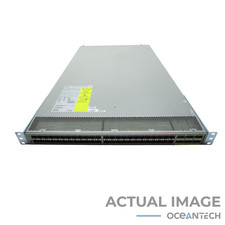
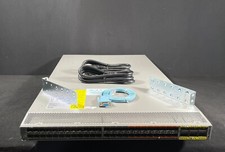
N5K-C5672UP-Ref Overview Cisco Nexus 5672UP switch (N5K-C5672UP) is a compact 1RU (1 Rack Unit), high-performance, low-latency 1/10/40-Gigabit Ethernet, Fibre Channel, and Fibre Channel over Ethernet (FCoE) switch. It runs the industry-leading Cisco NX-OS Software operating system, providing features and capabilities that are widely deployed. Quick spec of N5K-C5672UP-Ref - Product Code: N5K-C5672UP
- Performance: Layer 2 and 3 hardware forwarding at 1.44 Tbps; 1071 mpps (64-byte packets)
- Form factor: 1-rack unit
- Power Supplies: two 1+1 redundant, hot-swappable power supplies
- Fan Modules: 3
- Airflow: supporting both port-side intake (red handle) and fan-side intake (blue handle) airflow options for flexible mounting
- 10 GE: 48 ports
- 40 GE: 6 true QSFP ports
- Ports: 48 fixed 1 Gigabit and 10 Gigabit Ethernet ports of which 16 ports can be unified ports (UP)
- 10 and 40 Gbps FCoE: Yes
- Hardware VXLAN: Yes
- NVGRE capable: Yes
- Latency: 1 microsecond
- Physical (height x width x depth): 1.75 x 17.3 x 30 in. (4.4 x 43.9 x 76.2 cm)
- Weight: 32 lb (2 power supplies)
N5K-C5672UP-Ref Specification - Form factor:1-rack unit
- Number of ports:Up to 1152 with FEX
- 10 GE:48 ports
- 40 GE:6 true QSFP ports
- Unified ports:16 ports (Ethernet; FCoE; 2/4/8-gigabit FC)
- 10 and 40 Gbps FCoE:Yes
- Hardware VXLAN:Yes
- NVGRE capable:Yes
- Latency:1 microsecond
- Performance:
- Layer 2 and 3 hardware forwarding at 1.44 Tbps; 1071 mpps (64-byte packets)
- Support for up to 256,000 combined entries of MAC addresses and Address Resolution Protocol (ARP) entries
- Low latency of approximately 1 microsecond using cut-through forwarding for predictable, consistent traffic latency regardless of packet size, traffic pattern, or features enabled on 10 and 40 Gigabit Ethernet interfaces
- 25-MB buffer per 12 x 10 Gigabit Ethernet SFP+ interfaces
- Line-rate traffic throughput on all ports in Layer 2 and 3 mode
- Interfaces:
- 48 fixed 1/10 Gigabit Ethernet SFP+ ports with 16 of the 48 ports being unified, and 6 fixed 40 Gigabit Ethernet QSFP+ ports with 10 and 40 Gigabit Ethernet FCoE support on all respective ports and 2/4/8-Gbps Fibre Channel on all the unified ports
- Expansion module: 24 SFP+ unified ports plus 2 x 40 Gigabit Ethernet QSFP+ ports
- Conversion of 40 Gigabit Ethernet ports to 10 Gigabit Ethernet interfaces through QSFP+ breakout cable
- Fabric extension through the Cisco Nexus 2200 and 2300 platforms
- Layer 2 Features:
- Layer 2 switch ports and VLAN trunks
- IEEE 802.1Q VLAN encapsulation
- Support for up to 4000 VLANs
- Support for up to 4000 access control list (ACL) entries
- Rapid Per-VLAN Spanning Tree Plus (PVRST+) (IEEE 802.1w compatible)
- Multiple Spanning Tree Protocol (MSTP) (IEEE 802.1s): 64 instances
- Spanning Tree PortFast
- Spanning Tree root guard
- Spanning Tree Bridge Assurance
- Cisco EtherChannel technology (up to 16 ports per EtherChannel)
- Cisco vPC technology
- vPC configuration synchronization
- vPC shutdown
- Link Aggregation Control Protocol (LACP): IEEE 802.3ad
- Advanced port-channel hashing based on Layer 2, 3, and 4 information
- Jumbo frames on all ports (up to 9216 bytes)
- Pause frames (IEEE 802.3x)
- Storm control (unicast, multicast, and broadcast)
- Private VLANs
- Private VLAN over trunks (isolated and promiscuous)
- Private VLANs over vPC and EtherChannels
- VLAN remapping
- FabricPath
- EvPC and vPC+ with FabricPath
- Adapter FEX
- Data Center VM-FEX
- Support for up to 24 fabric extenders (Layer 2) with each Cisco Nexus 5672UP, 5672UP-16G, and 56128P Switch
- RDMA over Converged Ethernet (RoCE) using Data Center Bridging (DCB) support (DCB Exchange [DCBX] no drop and priority flow control [PFC])
- Layer 3 Features:
- Layer 3 interfaces: Routed ports, switch virtual interface (SVI), port channels, subinterfaces, and port-channel subinterfaces
- Support for up to 32,000 IPv4 and 8000 IPv6 host prefixes
- Support for up to 8000 multicast routes (IPv4)
- Support for up to 8000 IGMP snooping groups
- Support for 4000 Virtual Routing and Forwarding (VRF) entries
- Support for up to 4096 VLANs
- Equal-Cost Multipathing (ECMP) up to 64 ways
- 4000 flexible ACL entries
- Routing protocols: Static, Routing Information Protocol Version 2 (RIPv2), Enhanced Interior Gateway Routing Protocol (EIGRP), Open Shortest Path First Version 2 (OSPFv2), Border Gateway Protocol (BGP), and Intermediate System-to-Intermediate System (IS-IS)
- IPv6 routing protocols: Static, OPFv3, BGPv6, and EIGRPv6
- IPv6 VRF-lite
- BFD support: OSPFv2, BGPv4, EIGRP, and VRF instances
- Policy-Based Routing (IPv4 and IPv6)
- Hot-Standby Router Protocol (HSRP) and Virtual Router Redundancy Protocol (VRRP)
- IP direct broadcast
- vPC+ routing protocol peering
- ACL: Routed ACL with Layer 3 and 4 options to match ingress and egress ACL
- Multicast: Protocol Independent Multicast Version 2 (PIMv2) sparse mode, Source-Specific Multicast (SSM), offerir-PIM, Multicast Source Discovery Protocol (MSDP), IGMPv2 and v3, and Multicast VLAN Registration (MVR)
- VRF: VRF-lite (IP VPN); VRF-aware unicast; and BGP-, OSPF-, RIP-, and VRF-aware multicast
- Unicast Reverse-Path Forwarding (uRFP) with ACL; strict and loose modes
- Jumbo frame support (up to 9216 bytes)
- Support for up to 24 fabric extenders on each Cisco Nexus 5600 10-Gbps platform switch
- Quality of Service (QoS):
- Layer 2 IEEE 802.1p (class of service [CoS])
- 8 unicast queues and 8 multicast queues per port
- Per-port QoS configuration
- CoS trust
- Port-based CoS assignment
- Modular QoS CLI (MQC) compliance: IPv4 and IPv6
- ACL-based QoS classification (Layers 2, 3, and 4)
- Flexible TCAM carving
- MAC and ARP hardware carving
- MQC CoS marking
- Per-port virtual output queuing
- CoS-based egress queuing
- Egress strict-priority queuing
- Egress port-based scheduling: Deficit Weighted Round-Robin (DWRR)
- Control-Plane Policing (CoPP): IPv4 and IPv6
- Security:
- Ingress ACLs (standard and extended) on Ethernet and virtual Ethernet ports
- Standard and extended Layer 2 ACLs: MAC addresses, protocol type, etc.
- Standard and extended Layer 3 and 4 ACLs: IPv4 and IPv6, Internet Control Message Protocol (ICMP and ICMPv6), TCP, User Datagram Protocol (UDP), etc.
- Ingress policing
- VLAN-based ACLs (VACLs)
- Port-based ACLs (PACLs)
- Named ACLs
- Optimized ACL distribution
- ACLs on virtual terminals (vtys)
- ACL logging (IPv4 only)
- Dynamic Host Configuration Protocol (DHCP) snooping with Option 82
- Dynamic ARP Inspection
- IP source guard
- DHCP relay (up to 32 destinations)
- Ethernet port security
- IPv6 RACL, PACL, and VACL
- iSCSI type-length-value (TLV)
- High-Availability Features:
- Cisco In-Service Software Upgrade (ISSU) for Layer 2
- Hot-swappable field-replaceable power supplies and fan modules
- N+1 and N+N power redundancy
- N+1 fan module redundancy
- Management:
- Switch management using 10/100/1000-Mbps management or console ports
- CLI-based console to provide detailed out-of-band management
- In-band switch management
- Port-based locator and beacon LEDs
- Configuration synchronization
- Configuration rollback
- Secure Shell Version 2 (SSHv2)
- Telnet
- Authentication, authorization, and accounting (AAA)
- AAA with RBAC
- RADIUS
- TACACS+
- Syslog (8 servers)
- Embedded packet analyzer
- SNMPv1, v2, and v3 (IPv4 and IPv6)
- Enhanced SNMP MIB support
- XML (NETCONF) support
- Remote monitoring (RMON)
- Advanced Encryption Standard (AES) for management traffic
- Unified username and passwords across CLI and SNMP
- Microsoft Challenge Handshake Authentication Protocol (MS-CHAP)
- Digital certificates for management between switch and RADIUS server
- Cisco Discovery Protocol Versions 1 and 2
- RBAC
- SPAN on physical, PortChannel and VLAN
- ERSPAN
- Ingress and egress packet counters per interface
- Network Time Protocol (NTP)
- Cisco Generic Online Diagnostics (GOLD)
- Comprehensive bootup diagnostic tests
- Cisco Embedded Event Manager (EEM)
- Cisco Call Home
- Cisco Smart Call Home
- Default Interface
- Cisco Fabric Manager
- Cisco Prime DCNM
- CiscoWorks LAN Management Solution (LMS)
- Data Center Bridging:
- CEE- and IEEE-compliant PFC (per-priority Pause frame support: IEEE 802.1Qbb)
- PFC link distance support: 20 km
- CEE-compliant DCBX Protocol
- CEE- and IEEE-compliant enhanced transmission selection
- FCoE Features (Require Storage Services License):
- T11 standards-compliant FCoE (Fibre Channel-BB-5)
- T11 FCoE Initialization Protocol (FIP) (Fibre Channel-BB-5)
- Any 10 or 40 Gigabit Ethernet port configurable as FCoE
- SAN administration separate from LAN administration
- Fibre Channel forwarding (FCF)
- Fibre Channel enhanced port types: VE, VF and VNP
- Direct attachment of FCoE targets
- Fabric Device Management Interface (FDMI)
- Fibre Channel ID (FCID) persistence
- Distributed device alias services
- In-order delivery
- Port tracking
- Cisco FCoE NPV technology
- N-port identifier virtualization (NPIV)
- Fabric services: Name server, registered state change notification (RSCN), login services, and name-server zoning
- Per-VSAN fabric services
- Cisco Fabric Services
- Distributed device alias services
- Host-to-switch and switch-to-switch Fibre Channel-SP authentication
- Fabric Shortest Path First (FSPF)
- Standard zoning
- Enhanced zoning
- Cisco Fabric Analyzer
- Cisco DCNM-SAN
- Storage Management Initiative Specification (SMI-S)
- Boot from SAN over vPC and Enhanced vPC (EvPC)
- FCP
- VSAN trunking
- Fabric Device Management Interface (FDMI)
- Fibre Channel ID (FCID) persistence
- Distributed device alias services
- In-order delivery
- Port tracking
- Cisco NPV technology
- Fabric binding for Fibre Channel
- Port security
- Fibre Channel traceroute
- Fibre Channel ping
- Fibre Channel debugging
- Generic MIBs:
- SNMPv2-SMI
- CISCO-SMI
- SNMPv2-TM
- SNMPv2-TC
- IANAifType-MIB
- IANAiprouteprotocol-MIB
- HCNUM-TC
- CISCO-TC
- SNMPv2-MIB
- SNMP-COMMUNITY-MIB
- SNMP-FRAMEWORK-MIB
- SNMP-NOTIFICATION-MIB
- SNMP-TARGET-MIB
- SNMP-USER-BASED-SM-MIB
- SNMP-VIEW-BASED-ACM-MIB
- Layer 3 MIBs:
- UDP-MIB
- TCP-MIB
- OSPF-MIB
- BGP4-MIB
- CISCO-HSRP-MIB
- Ethernet MIBs:
- CISCO-VLAN-MEMBERSHIP-MIB
- CISCO-VTP-MIB
- Configuration MIBs:
- ENTITY-MIB
- IF-MIB
- CISCO-ENTITY-EXT-MIB
- CISCO-ENTITY-SENSOR-MIB
- CISCO-FLASH-MIB
- CISCO-SYSTEM-MIB
- CISCO-SYSTEM-EXT-MIB
- CISCO-IP-IF-MIB
- CISCO-IF-EXTENSION-MIB
- CISCO-NTP-MIB
- CISCO-IMAGE-MIB
- CISCO-IMAGE-CHECK-MIB
- CISCO-IMAGE-UPGRADE-MIB
- CISCO-CONFIG-COPY-MIB
- Monitoring MIBs:
- DIFFSERV-DSCP-TC
- NOTIFICATION-LOG-MIB
- DIFFSERV-MIB
- CISCO-CALLHOME-MIB
- CISCO-SYSLOG-EXT-MIB
- CISCO-PROCESS-MIB
- RMON-MIB
- CISCO-RMON-CONFIG-MIB
- CISCO-HC-ALARM-MIB
- LLDP-MIB
- Security MIBs:
- CISCO-AAA-SERVER-MIB
- CISCO-AAA-SERVER-EXT-MIB
- CISCO-COMMON-ROLES-MIB
- CISCO-COMMON-MGMT-MIB
- CISCO-RADIUS-MIB
- CISCO-SECURE-SHELL-MIB
- TCP/IP MIBs
- INET-ADDRESS-MIB
- TCP-MIB
- CISCO-TCP-MIB
- UDP-MIB
- IP-MIB
- CISCO-DNS-CLIENT-MIB
- Miscellaneous MIBs:
- START-MIB
- CISCO-LICENSE-MGR-MIB
- CISCO-FEATURE-CONTROL-MIB
- CISCO-CDP-MIB
- CISCO-RF-MIB
- CISCO-BRIDGE-MIB
- CISCO-FCOE-MIB
- CISCO-PORTCHANNEL-MIB
- CISCO-ZS-MIB
- Industry Standards:
- IEEE 802.1D: Spanning Tree Protocol
- IEEE 802.1p: CoS prioritization
- IEEE 802.1Q: VLAN tagging
- IEEE 802.1Qaz: Enhanced transmission selection
- IEEE 802.1Qbb: Per-priority Pause
- IEEE 802.1s: Multiple VLAN instances of Spanning Tree Protocol
- IEEE 802.1w: Rapid reconfiguration of Spanning Tree Protocol
- IEEE 802.3: Ethernet
- IEEE 802.3ad: LACP with fast timers
- IEEE 802.3ae: 10 Gigabit Ethernet
- IEEE 802.3ba: 40 Gigabit Ethernet (Applies to 40G SR4, SR4-S, LR4, LR4-S, and CSR4 optics only)
- SFF 8431 SFP+ CX1 support
- RMON

|
|