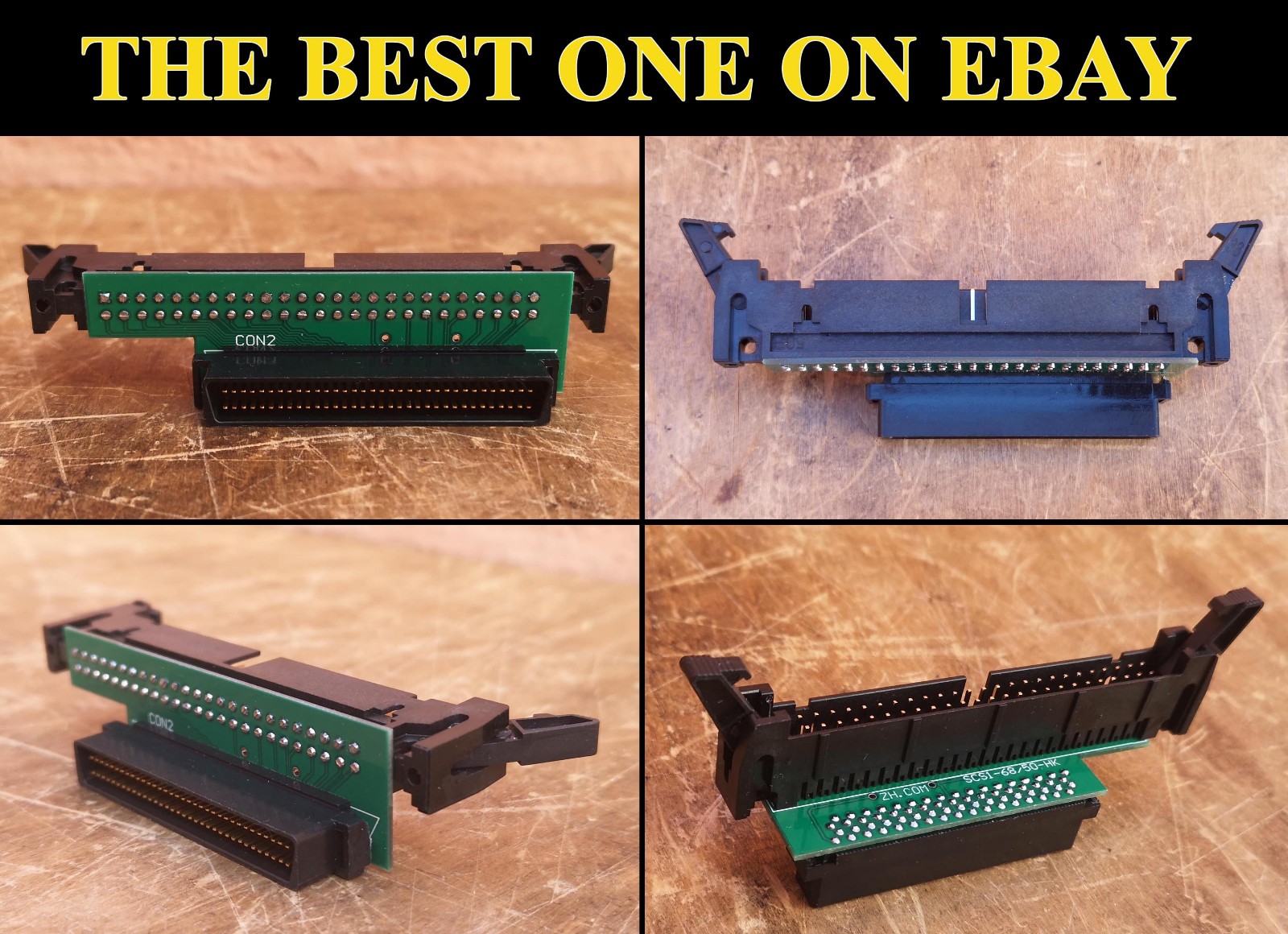
(Stock notice 11/7/2025: The other green one with the normal/cheaper box header has sold out, permanently. It is now out of production and won't be manufactured by Synhouse anymore. This superior model with the ejector header [shown in this listing] is also out of production but for now there is a small stock left as you see here.)(Stock notice 10/24/2025: Sorry, the -listed stock of the two greenmodels sold out months ago and I didn't notice and relist the remainingstock, so here you can see them listed now. Synhouse has four of these50-to-68 pin SCSI adapters listed, all manufactured by Synhouse, butthe two green models [cheaper models] are in very short supply andthere won't be any more of them. Production of the two black modelscontinues.)
Synhouse has customers in 43 countries.Synhouse ships to your country and has since before existed.If you are looking at a small/normal item in the Synhouse itemsand seeing no shipping options to your area or seeing a notice thatsays the seller doesn't ship to your address, this is incorrect. I'vebeen shipping to Australia, England, etc. since 1990, five years before even existed, and has deleted ALL the shipping options andprices I've spent many hours setting up, in order to enable International Shipping, and then tells people in the most commonlyshipped to countries that shipping is not available there. This is fakeand idiotic; had already been shipping there with the GlobalShipping Program for a few years, now says they don't with International Shipping AND deleted my own shipping options without mypermission or knowledge, when it could have and should have been leftin place as an option because at least it WORKS and doesn't knowwhat they are doing. This goes WAY back to 2017 with people in New Zealand (one of the mostcommonly shipped to Synhouse countries) telling me that I don't shipthere, and 1) multiple calls to didn't solve it, 2) they sometimessaid they solved it but didn't, and 3) said "Uhm, wait 24 hours and itwill be working.", which is how gets you off the phone. And Icould never get that New Zealand problem solved. The new problem sinceearly 2023 is deleting my own shipping options in order to puttheirs in, then theirs tells people no, the seller doesn't ship there,but I CAN manually set up a shipping method (usually with Synhouse it'sone price each for USA, Canada, Asia/Australia, and the rest of theworld. Now I'm getting messages like these:5/16/2023: Hi, Wondering how much shipping would be to Canada, postalcode T2N 2P7. Thanks!
Can you enable the international shipping option for me? I am veryinterested.
1/1/2024: Hi there can you post to London uk and how much would postagebe?
Hi how much would postage be to London England
Thanks for your reply. Im trying to check out but im get the messagesaying seller doesn't ship to your address. Please advise as i reallyneed the new faceplate.
1/30/2024: Hello synhouse, I have a T8 and would like to buy yourOptical-Emitter-Set just to make sure to have it in the future. Isthere a reason you don't ship to Germany? If you see that any small/normal Synhouse item does not ship toyou/your area, this is FAKE and wrong, please send an message totell me and I can manually enter shipping to your area AGAIN.Sorry for this incompetent platform I've been struggling with for 25years is a Synhouse exclusive:This is the ejector header model. Fifty pins is too long for a dual rowplastic box header, this is why they ALWAYS get busted out on one endor the other, usually with the last 8-10 pins on that end getting bentover like brush under a car tire, eventually sometimes breaking off oneof the pins.A proper ejector header with the locking latches giving leverage willpry the cable connector up off the pins and out of there evenly on bothsides at once, never breaking the box header housing and keeping thepins straight. Well worth the extra $3 for this one.Additionally, the ejector header with locking latches securely locksthe cable in place until snapped open. Look at the pathetic crap fromothers in the photo gallery that has to be held in with hot glue. Lame.The other sellers of the "ZH COM SCSI-68/50-HK" adapter design don'thave the ejector header and never did. THIS IS A SYNHOUSE EXCLUSIVE.Note the photo examples in the photo gallery, some tight installationapplications may not have the extra space needed for the ejectorlatches.Otherwise, this is exactly the same as the basic model also listed hereby Synhouse, so the usual listing listing is for a single piece SCSI drive adapter board ONLY, nohard drives are included, just the single piece SCSI drive adapterboard shown in the main/first photo you see in the photo gallery.For your money, you get (1) one.Additional pieces get super cheap combined adapter converts 68-pin Wide SCSI (sometimes called SCSI-3 UltraWide) to 50-pin (older, narrow, 8-bit) SCSI. In many situations, it probably works both ways, e.g. with a 68-pinhard drive on a 50-pin SCSI card/port or a 50-pin hard drive on a68-pin SCSI card/port using an internal 50-pin flat cable to connectthis adapter to the hard drive, but this is very specifically designedto be the first one of those, a 68-pin hard drive on a 50-pin SCSIcard/port, where it snaps right on the back of the 68-pin hard drivewith no cable necessary at all, it essentially becomes a 50-pin harddrive for installation/connection purposes. This is the great strengthof this particular super compact form factor adapter.The 68-pin male mini-Centronics MD68M connector means that it is to bepushed onto the back of a 68-pin SCSI hard drive on the 68-pin side,and the other side of this adapter has a 50-pin male dual row header onthe 50-pin side, and a 50-pin SCSI flat cable connects to that side.This is the greatest form factor of all time, once snapped on the backof the 68-pin hard drive, it almost disappears from view, no need tomount it anywhere. This design, unlike ANY other form factors out there selling today, canfit in ANY installation (unless you buy the more expensiveSynhouse-exclusive ejector header version with latches that may requiremore space around the rear side of the hard drive). This will even fitinside Kingston StorCase Data Express hard drive carriers, where themolded plastic adapters that are always wobbly and loose will not fitthere, and those completely stupid big flat 50-68-80 SCA adapters withall the jumpers on them from China will not fit, either. And anynumber of these needed will fit inside the Kingston DS100 4-baydesktop, DS400 or DS500 9-bay rack drive enclosures, etc..This one is the ultimate form factor for a 50-68 SCSI converter. This is why Synhouse has chosen to manufacture this one, as others havefor over 20 years, and Synhouse has manufactured four versions of thisadapter board (please look at the photos, these four versions are wellexplained in the last series of photos there), including two of themthat are black color and have a completely different SCSI circuit to beused with the New England Digital Synclavier music system. All this isexplained in the many sellers out there are selling a SCSI adapter with this exactsame circuit, green color and "ZH COM SCSI-68/50-HK" white lettering onthe board, so this one works the same as those BUT this one ismanufactured by Synhouse. See the photos that show the PCB designviewed on the computer by Synhouse, and the connectors and PCBs beforethey were assembled. Other sellers do not have the same quality of this board. Same circuitfor the same applications and works the same, yes, but the othersaren't made by Synhouse. Those sellers are resellers and many don'teven know what factory the boards they are reselling were made in. Somemight, actually, be commissioning the production of the boardsthemselves using the cheapest parts they can find in the commoditymarket, with only three pieces this isn't a complicated assembly, a lotof the China sellers do that and copy the products back and forthamongst themselves, but they are doing the assemblies badly and withoutany flux cleaning so the boards are filthy and corrosive-covered.Please see the comparison photos in the photo gallery of the Synhouseboard versus ALL the others. The difference is like night and day ifyou really know what to look for. Those sellers are using very, verycheap parts from the China commodity markets, where all the worstcomponent suppliers are vying to be the lowest price in searches forthat day, often these come from factories that might only make one ortwo connectors that they have the molds for, and make huge quantitiesof it, and use the cheapest, worst gold plating on the pins. Forexample, they buy the 50-pin 180° black dual row box header at theprice of $1.93 for 60 pieces, or $.03 cents each. THREE CENTS. No onereading this has access to those parts at those prices (but my Americanand European competitors on adapter boards are buying them resold onChina [and that other platform that has express in the name] forabout $.25-$.50 each in 100 quantity). I could buy those 3 centconnectors any time I want, but I wouldn't take them if they were free,they're trash and often look terrible in a few years. The problem forinexperienced customers of adapter boards (and the connectorsthemselves) is that they don't know this and think they all look thesame. Note for reference: This is not an "IDC" connector even thoughthousands of idiots say it is and list it that way, saying "IDC! IDC!IDC!". It is a 0.100"/2.54 mm pitch dual row connector, in this case a180° (or "straight" or "vertical") PCB mount type.IDC means Insulation Displacement Connector, and a PCB-mounted dual rowconnector like this 50-pin has no insulation to be displaced. A 50-pinIDC connector is a crimp type connector for flat cables, such as thedual row 50-pin on the flat cable that plugs into your hard drive, orthe 50-pin Centronics that mounts inside the panel of your SCSI harddrive enclosure. When making those cables, the flat cable is alignedover the cutting area of the pins, the backing is snapped over it, andthen compressed in a hand cable crimper tool (well, others do it thisway, Synhouse cables are made under a vertical press, which is commonin real factory production). Synhouse has very nice, very, very high quality 50-pin Centronics cablesets for SCSI hard drive/SCSI CD-ROM enclosures listed here on .The 2019 production (small leftovers from the Synhouse SCSI hard driveenclosure for Seagate Barracuda drives project) sold out, butproduction has resumed and these are now made in three lengths (totallength end to end if laid out) of 12.5"/32 cm, 15.5"/40 cm, each with apanel-mount 50-pin Centronics female on each end and a 50-pin dual rowfemale in between to go in the hard drive or CD-ROM, and 37"/94 cm witha panel-mount 50-pin Centronics female on each end and two 50-pin dualrow females widely spaced in between to go in the back of two harddrives or CD-ROMs, that longest version is made for 2U/3U drive rackslike Kingston that have two drives side by side, and is also good forlarger desktop known this super compact 50-68 adapter design a long time, I'veadmired it for years because it's the only one that fits anything andfits anywhere, is neatly cut out around the hard drive power connector,and doesn't require gobs of HOT GLUE to hold it steady as the moldedplastic adapters do (see the photos of the bad examples of how systemintegrators install those, GLUING them in so their customer'scomputers/hard drives won't stop working when those long molded plasticadapters wiggle, then fall out). This 50-68 adapter sold here is almostthe same as just using a native 50-pin drive, because once this issnapped on the back of the drive, it's almost invisible and you justconnect the 50-pin SCSI cable to it. And I know the 20+ year history ofthis design, where it originated, and how I came to have the PCB files(which is why I can now manufacture them all of them that I want myselfusing better quality connectors, offer an ejector header option, andbetter assembly and cleaning), but I'm not telling. I will offer theseto other sellers in bulk if they want Synhouse to manufacture some what this is---a very, very low priced adapter board, selling forthe price Synhouse is selling it for---it is the highest qualitypossible on all points (more below at the end of this listing in the "Aword about quality and detail" appendix section). Both connectors aremade in different factories, each selected by Synhouse instead of usingunknown origin commodity market parts, it took 10-15 days to get theseparts made, and the PCB is from a Synhouse-selected factory with alarge history with Synhouse; I've made so many circuit boards there(thousands) that I could replace all the Linoleum in my kitchen withtheir circuit boards and still have some left over. I know this factoryand I trust this factory. The assembly was done in another Synhouseselected facility, and Synhouse paid for the excellent cleaning thatyou see here. No one else has this, just look at the utterly filthyboards in their photos, they are splattered with corrosive flux thatbecomes worse later, and are made with the cheapest parts on applications for this board:This is a very standard design. This is a generic SCSI adapter design made by many, and used all overthe world for over 20 years. This one here has the same circuit as theother "ZH COM SCSI-68/50-HK" adapter sold by other here, so it worksthe same. Whatever this one doesn't work with, the same thing from theother sellers also don't work. This one is the same in that regard,it's just made better. My own testing with this design over the last 15+ years I've knownabout it is limited to a few SCSI computers where it worked, but noteto Synclavier (old high end computer music system from 1985) users,this cheap one doesn't work with the Synclavier, it will just sit thereand never find the drive (just like many Fujitsu, Maxtor, Micropolis,Quantum, etc. SCSI drives don't work with the Synclavier, and you needto end up using a Seagate hard drive [certain models, but most or allSeagate 50-pin SCSI drives should work with the Synclavier, but over9.1gb, such as 18gb or 36gb, should be avoided, it just makes ghostspace the Synclavier operating system can't even see when formattingbecause it can't see more than 8.2gb of hard drive space]), the otherSynhouse listings for the more expensive black ones (Synhouseboard/revision SCSI5068-222, available in a box header version and asuperior ejector header version) are the ones that work with theSynclavier.For anyone else doing SCSI adapting with this type of board, I can'tknow exactly which of the hundreds of SCSI applications it works with,but it's the same circuit as the others that look the same, so specificapplications are completely unsupported by Synhouse and you are on yourown there.If you buy this "ZH COM SCSI-68/50-HK" adapter here and find it doesn'twork in your application, then buy the same "ZH COM SCSI-68/50-HK"adapter from one of the other sellers and you will find that it doesn'twork with that same application, either. I'm just being honest. All the other sellers have never even SEEN aSCSI drive. Look at the photos here, then look at the photos of theother sellers of this item (as few as 3-4 of them around 2019-2020,more like dozens of them now, most of them in China, but some of themsold from USA by people from China, whether they are actually livinghere or using a US fulfillment company to get higher prices than theirneighboring competitors in China by saying "USA SELLER!"), not a ONE ofthem has ever even owned a single SCSI hard drive, much less set one upwith an adapter to check compatibility with different models andapplications. Synhouse has had over a thousand SCSI hard drives (downto about 200-300 now), which is why I can show a few real hard driveapplications in my photos and no one else can. Those humps can't eventake their own photos; They are all using the same photos they stolefrom each other. This is pathetic, dozens of sellers using the samestolen photos. This is why my photos are watermarked. Sorry about that,but it's how it is, EVERY other seller of this item is using photosthey stole, and they'll regret doing that to me. check the photos and make sure it is right for you. Noreturns/refunds.Same if you find it doesn't work for your application, noreturns/refunds. This is a proven design for over two decades, if itdoesn't work for your application, it didn't then, 50-68 pin conversion tip:People may say anything is correct just because they saw it start up ona computer/system one time, but the SCSI spec is the SCSI spec andshould be followed whenever possible.A 16-bit wide 68-pin SCSI hard drive can not be terminated with an8-bit narrow 50-pin SCSI terminator. It's just a fact. Sixteen bitlines plus the other control signals cannot be terminated by the eightdual resistors in an 8-bit narrow 50-pin SCSI terminator. This justcommon sense, and right from the SCSI spec, but it's baffling how manypeople don't get this. Synhouse manufactures SCSI cards, SCSI adapters,SCSI cables, and SCSI terminators and other products with dualtermination resistor arrays. I've seen SCSI systems set up by my out-of-business ex-competitors whodidn't understand this, and used new 68-pin SCSI hard drives onstorebought adapters because they ran out of the correct 50-pin SCSIhard drives and didn't care, then used all the old 50-way cabling andsnapped an 8-bit narrow 50-pin SCSI terminator on the end of the cablesetup (about 10 feet down the line, which is incorrect, but that's howthe system was made at the company, by people who didn't understand theSCSI spec, and those that were from the company never knew any better).This is not only not correctly terminating the 16-bit 68-pin SCSI harddrive, but it's even WORSE than using no terminator at all, becausehalf the lines are terminating and half the lines are not, and havesignals bouncing back and forth like crazy. What does this mean here? It means that if you want to use this adaptercorrectly, understand the limitations and follow here:1) If using this as intended, to put a 68-pin wide SCSI drive in asystem made for 50-pin narrow SCSI, your SCSI interface/port (it's notcalled a "SCSI controller", because the whole point of SCSI is thateach drive has it's own drive controller on it, as opposed to the MFMdrives that came before it) is 50-pin narrow SCSI, all your cabling is50-pin narrow SCSI................and presumably your SCSI terminatoris a 50-pin narrow SCSI terminator, so don't use it. 2) Use the full model drives, not the cut-rate cheap drive models. Inlate 1990s/early 2000s Seagate hard drives where the 50-pin narrow SCSIversion would have a model number ending in "N", in the 68-pin wideSCSI drives this would be a model number ending in "W" for the fullmodel drive. The cheaper versions of the same Seagate SCSI models would be themodels ending in "WC" (68-pin but bare bones without any onboardtermination), and the models ending in "LC" (80-pin SCA that are NOTmeant to be used outside of a dedicated SCA backplane server, no suchthing as a cable or terminator or enclosure for one, these are a wasteeven if you think you scored getting forty of them for two bucksapiece, they are useless if you're not running a server room withdedicated backplanes they plug directly into). IBM also had the samelower end model drives. Don't use them.If you use the full model drives, they will have onboard electronictermination (by the time of 68-pin wide SCSI hard drives, no one [butchimps like Micropolis] was using removable [Read: Already removed uponinstallation and you don't have it.] termination resistor packsanymore) that you can enable with jumper settings. Do this, and youwill A) have all the 16-bit lines and other control signals correctlyterminated, B) terminated the best way possible with active terminationICs instead of dual resistor arrays, and C) done in the best location,RIGHT on the drive without so much as one inch of unshielded cable runto the SCSI terminator. The SCSI spec says to terminate the last SCSIdevice on the chain............not run a cable down the road to a SCSIterminator in another location.What does this mean? It means if you do this correctly, you can't havemore than one 68-pin SCSI drive on the SCSI bus, because your SCSI busis really a 50-pin bus and all the cabling through it is, too. Thismeans you can only use one drive, and not snap four of these adapterson four 68-pin hard drives and run them all in a string on a 50-pincable. At least not if you are doing it correctly, according to theSCSI spec.For Synclavier users (old high end computer music system from 1985)this means using only one hard drive as noted above, not two (or more,but that's never been a good idea anyway, one is ALWAYS best). Also note that the Synclavier does NOT work with this cheap greenboard, it has to use one of the two more expensive black boards in theother listings, but I'm continuing here to explain the terminationissue as it relates to Synclaviers.The Synclavier has poor, intolerant SCSI, it doesn't work at all withMOST SCSI drives out there, and if someone figured out how to, forexample, get a Micropolis hard drive working on one, godspeed, you'regoing to learn later that it can't work with another drive on the samebus, often not even another of the same model, and it can't copyto/from another drive, or maybe only one and not the other, or with thedrives only in a specific order on the SCSI bus. There may have beenone or two Quantum brand drives in a very, very few systems, butthroughout the Synclavier range 1985-1992 and after the company closed,it was really just CDC (Control Data), Imprimis, and Seagate drives,which are all really the same thing, because Seagate bought out thoseother two, and continued production on many models with both the oldnumber on them plus a new Seagate "ST" model number. Other brands justdon't work well, if at all. The Synclavier is not a SCSI-basedcomputer, it didn't even have SCSI (or MIDI, or SMPTE) when it firstcame out, it was using an MFM hard drive with dual motor controllercables, etc., and it's not a smart desktop computer running cleverAdaptec apps that can work around small hard drive problems, it willjust crash on ANY irregularity or latency, if it even started up in thefirst place at all. And finally, this means that this adapter won't work (correctly,anyway) as the main system drive in any system with Direct-to-Disk (100kHz live recording option for the old system), because that has thesystem hard drive placed in the middle of the SCSI cable between twoSCSI cards in two computers, each of which are self-terminating, andonly 8-bit, so this can't possibly terminate all the lines on a 16-bit68-pin wide SCSI hard drive.Will it work on the audio tracking hard drives in a SynclavierDirect-to-Disk? At this point as I post this listing, I don't know andI don't care, as Synhouse still has the world's largest inventory ofthe correct 50-pin hard drives for those systems, and that is the mostdemanding SCSI application imaginable (tracking 2 tracks of 100 kHzlive audio to a WREN 6 or higher hard drive requires incredible datathroughput), it's hard enough setting those up with the correct drives,and I'm not yet interested in trying out kludges in order to use thewrong hard drives, as I still have the right drives in stock. It'sprobably inevitable, but not today.But theoretically, Synclavier Direct-to-Disk audio tracking hard driveswould not have the 8/16-bit termination problem described above,because the Direct-to-Disk only has one SCSI port wired directly to oneSCSI hard drive (and usually four of those setups running in parallel)which should be set with the SCSI termination active right on the harddrive itself.So the general advice on this is 1) you can use it with a plain singletower Synclavier if you are using only one hard drive as the mainsystem drive (and this is SUPERB in rack mounted fully self-containedinstallations with no external terminators or other garbage, see thebeautiful example in the photos), and 2) you can't use it with multipledrives or in Synclaviers with Direct-to-Disk (or PostPro, PostPro SD,etc. for the same will be safely packed for shipment.
Please see my other listings for SCSI items. I presently have more SCSIitems listed than anyone who has ever been on , and I haven't evendone 10% of my listings inquiries:I will offer these to other sellers in bulk if they want Synhouse tomanufacture some for them, I can list it right here on , 1,000pieces for $3,000 and $200 shipping (20 cents apiece for a thousandboards) with a 40 business day delivery time (estimated, but probably alittle faster than that). Or $2,000 for the files for the PCB design.All the other components (two connectors and PCB) can be listed here aswell if someone wants the bare PCBs or connectors, or both, but I don'tdo referrals, you can buy the parts yourself from your own suppliers(which are not as good as mine), or buy them here. My sources are mysources, no referrals. week of this first listing of this one, Synhouse has come out witheight new products, seven of which are assembled circuit boards, butnothing fancy, just very, very high quality like no one else here on can take a close look at the photos and please make note of theexceptionally high quality of assembly here. No one else making adapterboards and selling them here on even comes close to the Synhousequality. NO ONE. The quality of componentry is astounding across theSynhouse line of boards such as this one. Synhouse has vastly greater manufacturing and sourcing capability thananyone else selling here on , and it's not even close. Go on andclick the Synhouse listings and look at the last 90 days ofcompleted/sold listings, and see that Synhouse is a serious supplier ofhigh quality componentry that is NOT CHEAP, from 1980s drum machines onup to supplying a factory making current year model $150,000 audiomixing consoles. By comparison, in terms of the quality/detail of materials,componentry, and assembly/soldering/cleaning, everyone here on other than Synhouse is selling absolute trash, partly because NONE OFTHEM bring any manufacturing experience to the table when they startkicking out their maker "products" like adapter boards, which are dimea dozen here on , and one example seen here on three years ago10/19/2021 is noted for having more quality problems than could evenfit on the page. I had to stop pointing out problems and solutions tothem because there was no more room.A good number of Synhouse connector adapter boards (for SCSI, floppy,etc.), service extender boards, etc. are being introduced now, afterhaving only had a few in the past and rapidly selling out because notmany were made at first (such as the 34-pin edge card floppy disk driveadapter to connect 3.5" drives/flash emulators to 5.25" edge cardinterfaces, about 110 were quickly sold out when there was no way tomanufacture more of them because of muh pandemic and muh supply chaincrisis and muh port crisis), and I'm pointing out what's wrong with theothers, as time permits, because thequality/detail/assembly/construction problems on the crappy boards soldby others are limitless and neverending, and there's no reason forSynhouse to be undersold by noobs sticking unsuspecting buyers withtrash boards, selling to buyers who also apparently don't know a lotabout it, so I'm providing the information as I word about quality and detail:Real factory assembly with production soldering is always preferable.Home hand soldering DIY style is inferior from a few standpoints.That's just the way it is. Two of those reasons are detail and quality.In my entire career, I've never seen one of these home DIY sellerguys come out with a properly assembled/soldered board, and this evengoes four decades back to some of the late 1980s MIDI interface boards,and some recently seen 1990 work from one of the Synhouse competitors(done almost 9 years before Synhouse officially incorporated in 1999)was an absolutely horrifying mess of jumper wires, tape, and solderflux all over the place, and yeah, it didn't work anymore, not a bigsurprise after 34 years of excess flux gassing out over all theconnections. This is the inevitable end game for a lot of badly madeboards: Self-destruction.These chimps almost always hit the trifecta; 1) Using the wrong solder(a roll of hobby solder to solder it by hand), 2) using the wrongsoldering technique, and 3) following up with no cleaning at all (whichis in even greater need because of the first two screwups, it mighthave gotten by with no cleaning at all if it had been properly factorysoldered with the right solder, at least in some cases). 90% of thesolder sold at DK/Mouser are just ignored by these guys, they don'teven care to know what it is, because it costs 10x as much as the rollof hobby trash solder they always use. Well, there's a reason why itcosts more and a reason why ALL the customers for that solder aremaking money and these guys are not, those real companies like Synhouseare selling into a sales channel with an expectation of quality thatrequires those specialized materials. And it IS specialized, because, conversely, the production soldermaterials used for the Synhouse MIDIJACK, etc. wouldn't work very wellsoldering up a bunch of corroded/tarnished old switches, wires, andresistors from the electronic surplus shop. That WOULD require a higherflux solder (meaning it would need to be followed by even MOREcleaning, which these guys obviously don't do).The production of consumer grade circuits, metal, and other parts hasbeen 100% overseas for so many generations now that there's almost noone left in the first world who has ANY actual manufacturing experiencein these things (and I do mean "these things", making airplane parts atthat plant in Wichita doesn't count, it only shows what Rockwellhardness documentation is and how to make things that are too expensivefor consumers to buy), so now in the 2020s with all these littleniche/vintage market specialties, the car is being driven by absoluteknow-nothing "maker" types who, collectively as a group of millions ofguys, don't bring even five minutes of actual manufacturing experienceto the table. And their customers don't know any better, either, which is part of whyI'm trying to bring the buyers up to speed by teaching them whatquality is and what good details are and why it should be paid for, orat the very least, to know that one item that is much cheaper thananother is poorly made of crap materials components, and therefore ifthey really want to buy it, fine, but it SHOULD be at a drasticallylower price than the superior quality Synhouse item. And you see that right there benefits me, as I have tremendous priceadvantage on some materials, componentry, and engineering/labor lineitems, that is, if all else is equal, and I'm not using more expensiveparts for some reason (it's the COST of running the company and doingthings properly that is the major Synhouse expense, and almost none ofthe competitors have any of these expenses because they aren't realcompanies, 11/2024 I just paid 1,800 for the CAD drawing of a singlepart of an upcoming Synhouse product, I'll live and die without havinga single competitor who's E V E R paid out 1,800 for a CAD drawing, andit's the gross profits from the sales of existing Synhouse products andservices that pay for that), so if they are underselling me, I couldstill be making more profit at their same selling prices, but Ishouldn't need crawl on the floor to get low prices when I'm sellingsignificantly superior items into a very, very finite sized market (thenumber of people who can use it doesn't increase by me lowering theprice, there are only x number of vintage target machines out there,and that number is dropping, not increasing, so I'll never sell 10,000pieces of anything).These /home guys may spend 8 minutes badly soldering a connectoradapter board while my girls do them in 43 seconds each and the resultis 10x better than that guy ever gets, which is not surprising sincethey have 15,000,000x more recent production experience, and thisforces the /home guys into working many, many hours for free andthey end up counting only the cost of PCBs and connectors into theirimaginary "profit", without even counting their labor cost when I haveALWAYS had to count my labor cost. I knocked out my first MIDI competitor in 2000 that way, the Synhouseproduct was made robotically in the factory in Simi Valley and sold for$99 while theirs was made with 6-8 hours unpaid sloppy home hand laborafter work to sell for $169 when the components alone were costing$220/each, this was a "loss leader" strategy that didn't pan out andthey are 23 years gone now (and YES, Synhouse is making money on theseproducts and any that aren't profitable are shut down swiftly [if youEVER see a price reduction on a Synhouse product, and I can only thinkof two of those off the top of my head, plus those that never seem toget a price increase, this means the stock is being sold off and itwon't be continuing in production], those profits pay for thedevelopment/manufacturing of more and more and more Synhouse products,that's why I have more catalog than everyone else combined instead ofgiving up because it's too hard always selling at a loss, and I havekept items in production for as long as 26 years now).So the customers for these simple adapter boards, etc., who are mostlyrelatively electronic/repair/DIY familiar, should try to learn a littlemore about what quality and detail is, and I'm pointing that out insome of the photos and in these writings. Customers show me things all the time, and I'm just astounded by wellaccepted products that are SO badly made, like someone showing me theirZuluSCSI board setup, good grief, that design/manufacture showsabsolutely NO manufacturing knowledge and background, or flash floppyemulator boards where one very stupid noob mistake in the design makesthe thing 3x as expensive to assemble, and several mistakes made inchoosing the items on the bill of materials makes it MUCH moreexpensive to make and even further increases the assembly cost, andleads to a less durable and therefore less reliable board. And no, I'm generally not impressed by the videos from theself-proclaimed soldering experts (who almost never actually make aliving from a business that uses their skills and judgment), thoughthese are mostly showing their SMT surface mount soldering techniquesand less of the pin through hole board/soldering style we arediscussing here, I've never seen industry utilizing these types oftricks and techniques, as they are time consuming and ultimately veryexpensive, and not conducive to production trained factory workersdoing them.This is similar to the 3D printing geniuses all over social media andvideos, can you actually see them making money commercially selling therough surfaced crumbly 3D printed garbage they are making? Of course not, except for making money from the video sponsors they areshilling for (for example, 3D printer Matt Perks/Huel AKA Hurl mockingpeople eating "Another sandwich!" instead of having a meal of mixingHurl powder in water and drinking that for lunch).As time permits, the new Synhouse designs are sent to factory PCBAassembly, not soldered with hobby solder at the kitchen table afterwork like everyone else's, because managing manufacturing for SynhouseIS my work since 1999, and all Synhouse circuit boards (maybe exceptfor a few simple proof-of-concept test pieces done during the 2020 fakepandemic lockdowns) are manufactured on contract in factories sinceJune 1999, and that's been more than 100 different designs just since2012, or maybe it's nearly 200 designs by now, I lost count and haverarely updated company board listings, as I keep doing more and moredesigns faster than I can update the documentation. Sometimes a newSynhouse product design takes only half a day (if it's only two genericconnectors on a 2-layer PCB and no active circuitry, power supply,enclosure, etc.), then I can move on to a few more product designprojects, as my part of the factory production is usually just my ownin-person worker instruction and supervision of the work itself, whichis less and less needed as time goes on and the suppliers get a betterhandle on making the Synhouse products.The week of this first listing of this product for sale here, Synhousehas come out with EIGHT new products, seven of which are assembledcircuit boards, but nothing fancy, just very, very high quality like noone else here on can do. And every one of them had PCBA assemblyin a factory.Synhouse is utterly peerless in this regard.