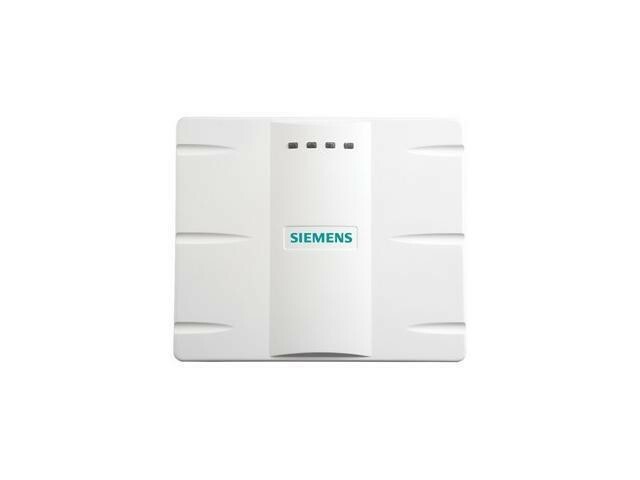
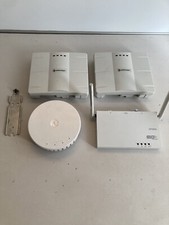
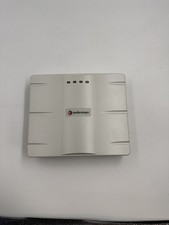
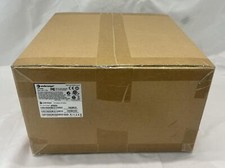
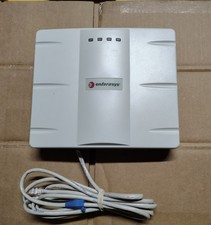
Used Siemens Enterasys WS-AP3610 Dual Radio 802.11a/b/g/n 300/600Mbps. Condition is Used.*** I HAVE A LOT OF THESE!!! ****** NEGOTIATE WITH ME ****** MASSIVE DISCOUNT FOR QUANTITY BUYS, JUST "BUY NOW" AND MESSAGE ME!!! ***These were pulled from a working system at a college and bought at sale.
Units appear to be in good condition, with normal signs of use, however they are sold as is with no returns.
Feel free to contact me for more information. Feel free to negotiate for combined shipping, multiple units & etc. Units will vary in appearance (most notably stickers and/or normal color fading of outer shell) from the photos. Again, contact me if you need any additional details or clarification.
Note also . . . these units are PoE . . . which is "Power Over Ethernet" . . . so a power supply would be hitched up next next to the
TECHNICAL INFORMATION PROVIDED FROM THE MANUFACTURER'S WEBSITE, OTHER WEBSITES AND OTHER PROMOTIONAL MATERIAL TO THE BEST OF MY KNOWLEDGE, CORRECT BUT NOTGUARANTEEDTO BE SO!!! MODEL NUMBER IS CORRECT, SO DO YOUR OWN RESEARCH FOR YOUR APPLICATION AS WELL!!!
The Extreme Networks Wireless solution optimizes distribution of the processing load between Access Points (APs) and wireless controllers to deliver exceptional performance while remaining easy to manage. Complex, time-sensitive functions such as QoS, encryption, policy enforcement, rate limiting, and dynamic channel selection are handled by the AP, while global functions like configuration, roaming, security management, and policy control are centralized at the wireless controller or the Extreme Networks NetSight Management Suite. Furthermore, the innovative Extreme Networks Wireless solutions-oriented architecture is able to determine how to forward traffic for the highest performance and reliability for each application. The result is a flexible and dependable WLAN infrastructure that can easily be leveraged to deploy VoWLAN and new high-performance solutions such as HD video.
- Full 802.11n 3x3 MIMO functionality using standard 802.3af PoE
- Easy and cost-effective migration path to 802.11n
- Flexible architecture supports centralized and/or distributed traffic forwarding for voice/video/data applications
- Policy enforcement and rate limiting at the AP support diverse deployments
- Unified wired/wireless role-based access control with guest networking
Extreme Networks Wireless APs use the most sophisticated standards to ensure effective security and client compatibility. Using the 802.11i (WPA2) standard, wireless LAN deployments can utilize 802.1X or PSK authentication and AES, TKIP, or WEP encryption. These options ensure secure authentication and seamless integration of the APs with the wired network infrastructure.
Extreme Networks Wireless APs work together to prevent interference and optimize RF sharing. Each AP is able to intelligently and dynamically adjust its transmit power and channel based on information related to neighboring APs as well as external interference or channel occupation. This ensures optimal performance for all wireless clients. If an AP fails, neighboring APs will increase power to maintain coverage in the affected area. The APs also support RF channel plan selection with the option of supporting 3-channel, 4-channel or a fully custom configuration.
Features:
Extreme Networks Wireless indoor 802.11n APs are exceptionally power-efficient, ensuring that they can run on industry-standard 802.3af PoE infrastructure. Many 802.11n APs exceed the power consumption limits of the 802.3af standard specification for PoE when configured for 3x3 MIMO on both radios (Note: AP3605 supports 2x3 MIMO only). These solutions demand the use of AC power adaptors or costly upgrades to pre-standard or proprietary PoE infrastructures to achieve optimal RF performance.
Extreme Networks Wireless Access Points will securely and automatically register with an available wireless controller and download their configurations, simplifying deployment and operational effort. APs can immediately provide service to users without having to be manually configured.
Adaptive Solutions-Oriented WLAN Architecture
Most WLAN solutions force network administrators to choose between a centralized or distributed architecture. A significant advantage of Extreme Networks Wireless is that it can support both deployment models simultaneously, offering significant flexibility benefits over other solutions. Network administrators can assign a topology (centralized or distributed) via policy to an individual user or group of users. A specific SSID can also be statically mapped to a given topology without any restrictions, so that the wireless LAN infrastructure can efficiently adapt to customer-specific business requirements and applications.
A centralized architecture requires all traffic to be backhauled to a centralized controller. With the higher data rates of 802.11n APs, traffic loads on the wired network can be much greater than those created by legacy 802.11a/b/g APs. Depending on the size of the WLAN deployment and how much data is forwarded to the centralized controller, significant congestion may result.
A fully distributed deployment eliminates backhauling traffic to a controller but increases the processing complexity for real-time mobile applications that require seamless cross-subnet roaming (e.g. VoWLAN). This can force IT managers to either create a large broadcast domain or apply many VLANs.
With Extreme Networks Wireless, network administrators are able to create WLAN services and policies, which together can dynamically assign traffic forwarding rules to users and groups, limit data flows and control admission on a per user and per SSID basis. With the flexibility to provision services and enforce policies at the AP, wireless traffic can be bi-directionally limited to user-defined thresholds, filtered, and locally switched without the need to tunnel it back to the controller. In both cases, unwanted traffic does not traverse costly WANs or aggregating switches before being dropped at the controller. This is achieved by the unique ability to perform packet inspection at the AP, where the requested service and destination is identified and then used to filter, switch, or rate limit accordingly. The result is optimized responsiveness and performance for users and services. Easily adapted to diverse customer network configurations whether they comprise single building, local campus or routed remote offices, the Extreme Networks Wireless solutions-oriented architecture simplifies deployment and reduces implementation costs.
Survivable Branch Office
Each Extreme Networks Wireless Access Point supports DRM. Although DRM is centrally managed and configured by the controller, DRM functions as a fully distributed system managing channels and transmit power allowing the WLAN infrastructure to adapt to RF interference (802.11 and others), heavy channel utilization, and AP failures.
Flexible Client Access (FCA)
To ensure uninterrupted access, Extreme Networks Wireless Access Points automatically adjust their settings to continue to optimally service clients when adjacent APs fail or when the link back to the controller is lost.
In addition, Extreme Networks Wireless APs can be configured to dynamically redirect traffic to a secondary wireless controller if the primary wireless controller fails. When the failover mode is enabled, APs automatically register to both a primary and secondary wireless controller, ensuring high availability of the WLAN service and robustness for real-time applications
Security
Extreme Networks Wireless APs provide strong encryption and authentication with the use of 802.11i standards and captive portal.
Extreme Networks Wireless APs can be configured as part time or full time sensors to detect rogue APs or to detect and contain security threats with the Wireless Management Suite (WMS) Wireless Intrusion Prevention System (WIPS).
In addition, each AP can be configured with a certificate enabling the AP to authenticate to the wired network. The network is then fully protected against attempted re-use of the Ethernet port by unplugging the AP and connecting directly to the Ethernet cable, as a point of entry into the corporate network.
Quality of Service (QoS)
Extreme Networks Wireless APs support extensive functionality to ensure the best service for all multimedia applications. Extreme Networks Wireless APs use IP DiffServ/Precedence/TOS and 802.11e WMM to differentiate and prioritize wireless traffic. On the wired side, IP DiffServ/Precedence/TOS, and 802.1p are used to differentiate and prioritize traffic.
For 802.11 traffic, Extreme Networks Wireless APs support additional QoS features including 802.11e TSPEC (Call Admission Control) and U-APSD (automatic power save) to ensure high quality and power efficient services for voice, video, and data applications.
In addition, the original packet IP prioritization can be maintained on both the wireless and wired networks by enabling the Adaptive QoS mechanism. This feature allows tunneled and wireless packets to retain their IP prioritization value end-to-end. Furthermore, Extreme Networks Wireless APs allow IT managers to define custom mappings of different types of prioritization schemes to ensure that user traffic is properly differentiated when entering the wired network.
Bandwidth Control and Prioritized Service Delivery
Extreme Networks Wireless provides administrators with the means to control bandwidth utilization and prioritize service delivery. Unique, granular packet inspection capabilities at the AP continuously monitor and assess user and service destinations. Based on topology, filter rules and data rate thresholds defined in the user policy, a packet may be tunneled back to the controller, switched at the AP, or dropped. A user who violates a rate limit policy attribute could, for example, be directed to a quarantine segment attached to local AP or further rate limited.
Benefits:
Support for demanding voice/video/data applications to enhance mobile worker productivity and convenienceSeamless roaming across an entire multi-subnet campus without the need for cumbersome client softwareMigrate to 802.11n without requiring power, switching, or cabling upgradesAdaptive architecture reduces complexity and optimizes information flow for each applicationDynamic Radio Management ensures optimal AP coverage and maximizes the availability and quality of wireless service across the enterpriseWireless Distribution Service (WDS) enables Extreme Networks Access Points to wirelessly interconnect while extending WLAN service to distant areasFlexible Client Access optimizes throughput for 802.11n clients in today's mixed a/b/g and n client environmentsWireless Intrusion Prevention (WIPS) functions provide continuous scanning, threat classification, rogue AP detection, and countermeasures against possible attacksAP personality can change to full time and part time sensors to perform Wireless Intrusion Detection and Prevention (WIPS) for effective detection and prevention of rogue APs and other threatsSupport and Service
Specifications:
802.11b: 1, 2, 5.5, 11 Mbps
802.11g: 1, 2, 5.5, 6, 9, 11, 12, 18, 24, 36, 48, 54 Mbps
802.11n: Up to 300 MbpsFrequency Bands802.11a/n:
5.15 to 5.25 GHz (FCC / IC / ETSI) – Indoor
5.25 to 5.35 GHz (FCC / IC / ETSI) - Indoor / Outdoor
5.47 to 5.725 GHz (FCC / IC / ETSI) – Indoor
5.725 to 5.850 GHz (FCC / IC) - Indoor / Outdoor
2.400 to 2.4835 GHz (FCC / IC / ETSI) - Indoor / OutdoorWireless Modulation802.11a: OFDM 802.11b: DSSS
802.11g: DSSS and OFDM
802.11n: BPSK, QPSK, 16QAM, 64QAM with OFDM 802.11n
Packet aggregation: A-MPDU, A-MSDUReceive Sensitivity (typical)802.11a: 6 Mbps/-93 dBm, 54 Mbps/-80 dBm 802.11n 5 GHz HT20 Mode: 6.5 Mbps(MCS0)/-94 dBm, 130 Mbps(MCS15)/-72 dBm 802.11n 5 GHz HT40 Mode: 15 Mbps(MCS0)/-89 dBm, 300 Mbps(MCS15)/-68 dBm 802.11b: 1 Mbps/-93 dBm, 11 Mbps/-90 dBm 802.11g: 6 Mbps/-92 dBm, 54 Mbps/-81 dBm 802.11n 2.4 GHz HT20 Mode: 6.5 Mbps(MCS0)/-94 dBm, 130 Mbps(MCS15)/-74 dBm 802.11n 2.4 GHz HT40 Mode: 15 Mbps(MCS0)/-88 dBm, 300 Mbps(MCS15)/-69 dBmInterfaces# 10/100/1000 Base T Ethernet autosensing link1Console port for the ease of installation and managementYESMountingWall mounting bracketYESDrop-ceiling mounting 0º C to +50º C (+32º F to +122º F)
Humidity 0%‐95% (noncondensing)
• ICES-003 Class B
• RSS-210, RSS-102 (RF Exposure)
• R&TTE Directive 1999/5/EC EN 301 893
• EN 300 328
• 2004/108/EC EMC Directive
• EN 301 489 -1 & 17
• EN55011/CISPR 11 Class B, Group 1 ISM
• EN55022/CISPR 22 Class B
• EN55024/CISPR 24
• EN / UL 60601-1-2
• EN 50385MechanicalDimensions (W x H x L)(8.4” x 2.2” x 7.1”) – AP3610Weight628.4g – AP3610Max power consumption12.8W (Typical 11W)ng:8px; vertical-align:top; border:1px solid rgb(221, 221, 221);">YESPre-Authentication (Pre-Auth)YESOpportunistic Key Caching (OKC)YESSupport voice, video and data using the same SSIDYESPrioritize voice over data for both tagged and untagged trafficYESRate limiting (rule and user-based)YESRule and role based QoS processingYESMulticast Rate ControlMulticast to Unicast ConversionYESAdaptable rate multicastYESPower save mode optimization for multicastYESWireless ServicesMedia Access ProtocolCSMA/CA with ACKData Rates802.11a: 6, 9, 12, 18, 24, 36, 48, 54 Mbps
802.11b: 1, 2, 5.5, 11 Mbps
802.11g: 1, 2, 5.5, 6, 9, 11, 12, 18, 24, 36, 48, 54 Mbps
802.11n: Up to 300 MbpsFrequency Bands802.11a/n:
5.15 to 5.25 GHz (FCC / IC / ETSI) – Indoor
5.25 to 5.35 GHz (FCC / IC / ETSI) - Indoor / Outdoor
5.47 to 5.725 GHz (FCC / IC / ETSI) – Indoor
5.725 to 5.850 GHz (FCC / IC) - Indoor / Outdoor
2.400 to 2.4835 GHz (FCC / IC / ETSI) - Indoor / OutdoorWireless Modulation802.11a: OFDM 802.11b: DSSS
802.11g: DSSS and OFDM
802.11n: BPSK, QPSK, 16QAM, 64QAM with OFDM 802.11n
Packet aggregation: A-MPDU, A-MSDUReceive Sensitivity (typical)802.11a: 6 Mbps/-93 dBm, 54 Mbps/-80 dBm 802.11n 5 GHz HT20 Mode: 6.5 Mbps(MCS0)/-94 dBm, 130 Mbps(MCS15)/-72 dBm 802.11n 5 GHz HT40 Mode: 15 Mbps(MCS0)/-89 dBm, 300 Mbps(MCS15)/-68 dBm 802.11b: 1 Mbps/-93 dBm, 11 Mbps/-90 dBm 802.11g: 6 Mbps/-92 dBm, 54 Mbps/-81 dBm 802.11n 2.4 GHz HT20 Mode: 6.5 Mbps(MCS0)/-94 dBm, 130 Mbps(MCS15)/-74 dBm 802.11n 2.4 GHz HT40 Mode: 15 Mbps(MCS0)/-88 dBm, 300 Mbps(MCS15)/-69 dBmInterfaces# 10/100/1000 Base T Ethernet autosensing link1Console port for the ease of installation and managementYESMountingWall mounting bracketYESDrop-ceiling mounting 0º C to +50º C (+32º F to +122º F)
Humidity 0%‐95% (noncondensing)
• ICES-003 Class B
• RSS-210, RSS-102 (RF Exposure)
• R&TTE Directive 1999/5/EC EN 301 893
• EN 300 328
• 2004/108/EC EMC Directive
• EN 301 489 -1 & 17
• EN55011/CISPR 11 Class B, Group 1 ISM
• EN55022/CISPR 22 Class B
• EN55024/CISPR 24
• EN / UL 60601-1-2
• EN 50385MechanicalDimensions (W x H x L)(8.4” x 2.2” x 7.1”) – AP3610Weight628.4g – AP3610Max power consumption12.8W (Typical 11W)