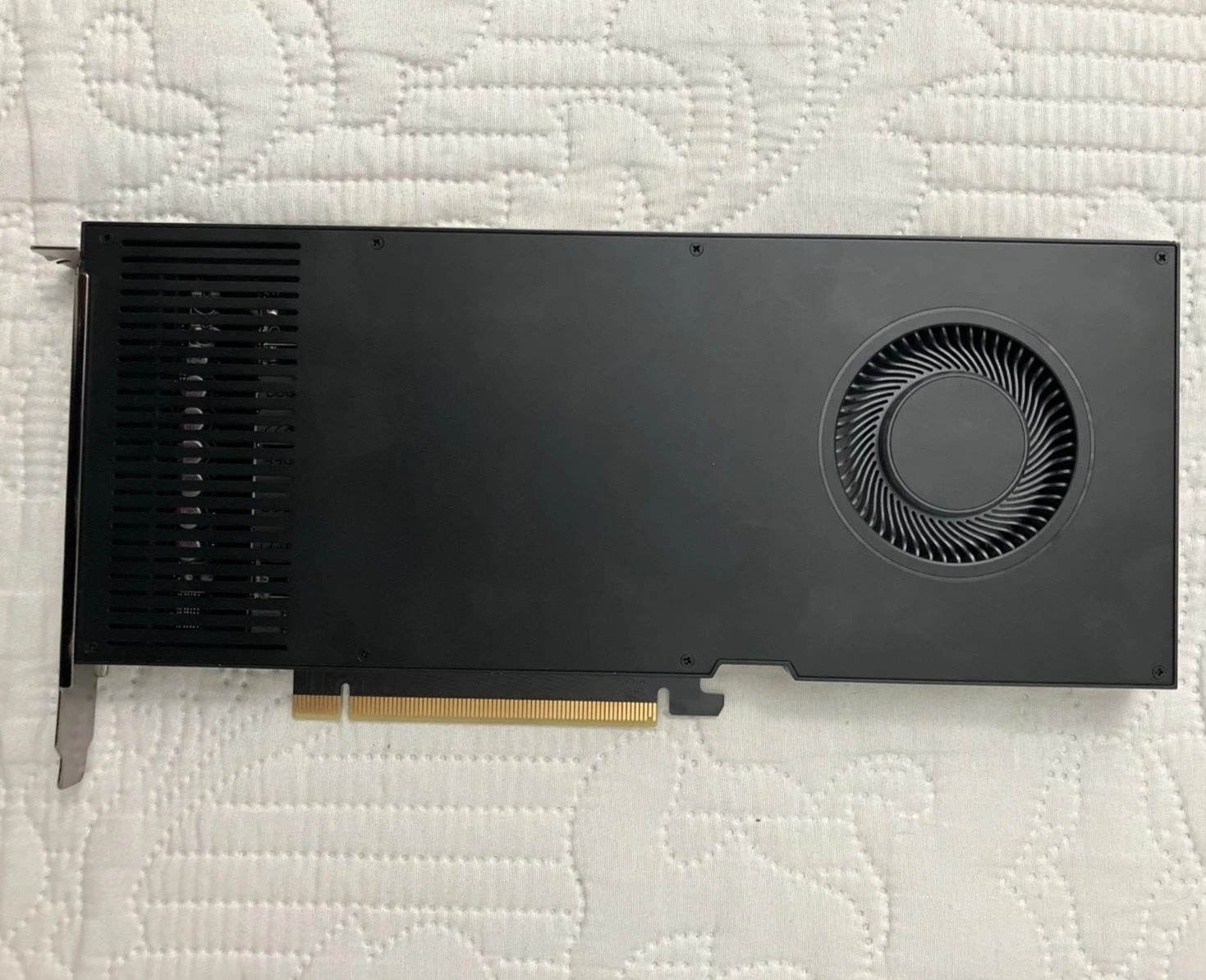
NVIDIA RTX A4000 16GB GDDR6 ECC Professional Workstation Graphics Card PCIe 4.0Item Introduction
Upgrade your professional workstation, rendering system, engineering computer, or GPU-accelerated computing environment with the NVIDIA RTX A4000 16GB GDDR6 Professional Graphics Card.
Built on NVIDIA's powerful Ampere GPU architecture, the RTX A4000 is a professional workstation graphics processor designed for demanding applications involving computer-aided design (CAD), 3D modeling, real-time rendering, engineering simulation, scientific computing, artificial intelligence, machine learning, video production, and advanced visualization.
The RTX A4000 combines 6,144 NVIDIA CUDA cores, 192 third-generation Tensor cores, 48 second-generation RT cores, and 16GB of GDDR6 graphics memory with ECC support into an efficient, single-slot PCI Express graphics card.
Its 16GB framebuffer provides substantial dedicated GPU memory for large 3D models, complex scenes, high-resolution textures, computational workloads, and GPU-accelerated applications.
The card features a 256-bit memory interface delivering up to 448 GB/s of memory bandwidth, allowing large amounts of graphical and computational data to move efficiently between the GPU and its onboard memory.
With 19.2 TFLOPS of peak single-precision (FP32) compute performance, the RTX A4000 delivers considerable processing capability for professional graphics and general-purpose GPU computing.
The card also incorporates dedicated hardware for accelerated ray tracing and AI workloads. Its 48 second-generation RT cores accelerate ray-tracing operations, while its 192 third-generation Tensor cores accelerate supported AI, matrix-computation, and deep-learning workloads.
Unlike many high-performance graphics cards requiring substantial chassis space, the RTX A4000 uses a single-slot, full-height design measuring approximately 9.5 inches long and 4.4 inches high.
This compact configuration makes it particularly attractive for compatible professional workstations, rackmount computing systems, and other environments where PCIe slot availability is limited.
The RTX A4000 also features four full-size DisplayPort 1.4a outputs, supporting advanced multi-monitor configurations, high-resolution displays, and professional visualization environments.
Its active cooling system and reference 140W total board power rating provide a balance of workstation-class performance and power efficiency.
Designed for professional environments, the RTX A4000 supports NVIDIA's professional graphics driver ecosystem, CUDA acceleration, RTX ray tracing, NVIDIA Mosaic, NVIDIA RTX Desktop Manager, and numerous professional graphics and compute APIs.
Whether used for 3D design, architecture, engineering, scientific visualization, rendering, content creation, AI development, or other GPU-accelerated workloads, the NVIDIA RTX A4000 16GB provides a versatile combination of professional graphics performance, substantial ECC-capable GPU memory, and space-efficient construction.
Item FeaturesNVIDIA Ampere GPU Architecture
The RTX A4000 is based on NVIDIA's Ampere architecture, incorporating dedicated hardware for conventional graphics processing, real-time ray tracing, and AI-accelerated computation.
Ampere introduces architectural improvements in CUDA processing, Tensor operations, ray tracing, and memory handling compared with earlier NVIDIA professional GPU generations.
The RTX A4000 integrates these capabilities into a single workstation graphics processor.
6,144 NVIDIA CUDA Cores
The RTX A4000 contains:
6,144 CUDA Cores
CUDA cores execute parallel computational operations used in graphics rendering and GPU-accelerated computing.
These processors can accelerate supported workloads involving:
Actual acceleration depends on the software and its implementation of GPU computing.
16GB GDDR6 Graphics Memory
The card features:
16GB GDDR6 VRAM
This dedicated memory capacity allows the GPU to accommodate substantial graphical and computational datasets.
Potential applications include:
The ability to process a particular dataset or model depends on its memory requirements and software configuration.
ECC Graphics Memory Support
The RTX A4000 supports:
ECC – Error-Correcting Code
ECC provides mechanisms for detecting and correcting certain errors affecting graphics memory.
This capability is particularly valuable in professional environments where computational accuracy and data integrity are important.
Potential applications include:
ECC support does not guarantee that every possible memory error can be corrected or that every application is protected against all forms of data corruption.
256-Bit Memory Interface
The RTX A4000 features a:
256-bit memory bus
The wide memory interface supports efficient movement of data between the GPU and its 16GB GDDR6 framebuffer.
448 GB/s Memory Bandwidth
NVIDIA specifies:
448 GB/s memory bandwidth
This high-bandwidth memory subsystem supports graphics-intensive and computational workloads requiring rapid access to onboard GPU memory.
48 Second-Generation RT Cores
The RTX A4000 includes:
48 NVIDIA Second-Generation RT Cores
RT cores accelerate ray-tracing operations used to simulate the behavior of light in computer-generated environments.
Supported applications can use hardware ray tracing for:
Ray-tracing acceleration requires compatible software.
192 Third-Generation Tensor Cores
The GPU includes:
192 NVIDIA Third-Generation Tensor Cores
Tensor cores accelerate specialized matrix operations commonly used in artificial intelligence and machine learning.
Potential applications include:
Software support is required to take advantage of Tensor acceleration.
Up to 19.2 TFLOPS FP32 Performance
NVIDIA specifies peak single-precision compute performance of:
19.2 TFLOPS
FP32 performance describes the GPU's theoretical processing throughput for single-precision floating-point operations.
This capability is useful in numerous professional graphics and compute applications.
Actual application performance depends on workload characteristics, software optimization, memory requirements, and system configuration.
37.4 TFLOPS RT Core Performance
NVIDIA rates the RTX A4000 for:
37.4 TFLOPS RT Core Performance
This manufacturer-reported figure represents the card's peak rated ray-tracing performance under NVIDIA's specified measurement methodology.
153.4 TFLOPS Tensor Performance
The RTX A4000 provides:
Up to 153.4 TFLOPS Tensor Performance
This manufacturer-reported peak figure incorporates supported sparsity acceleration.
It should not be interpreted as conventional FP32 CUDA processing performance.
PCI Express 4.0 x16 Interface
The card connects through:
PCI Express 4.0 x16
PCIe 4.0 provides high-bandwidth communication between the GPU and the host system.
The card can operate in compatible PCIe slots supporting earlier generations, subject to platform compatibility and the bandwidth limitations of the host interface.
Single-Slot Form Factor
The RTX A4000 uses a:
Full-Height, Single-Slot Form Factor
Approximate physical dimensions:
Height: 4.4 inches / 111.8mm
Length: 9.5 inches / 241.3mm
Expansion-slot thickness: Single-slot
This design is particularly advantageous for workstations requiring multiple expansion cards or systems with limited available slot space.
The card still requires adequate airflow, clearance, and power connections.
Active Cooling System
The RTX A4000 uses an:
Active Cooling Solution
The reference design incorporates a fan-based cooling assembly intended to manage GPU temperatures during operation.
Proper chassis airflow remains essential, particularly in systems with multiple installed graphics cards.
140W Reference Board Power
The standard NVIDIA RTX A4000 reference design is specified at:
140W Total Board Power
This provides substantial professional GPU capability within a comparatively moderate power envelope.
Actual power consumption depends on workload, system configuration, and board implementation.
6-Pin PCIe Power Connector
The standard RTX A4000 uses:
One 6-Pin PCIe Auxiliary Power Connector
The host system must provide the appropriate power connection and sufficient overall power capacity.
The 6-pin connector supplements the power available through the PCIe expansion slot.
Four DisplayPort 1.4a Outputs
The RTX A4000 includes:
4 × DisplayPort 1.4a
These full-size DisplayPort connections support professional multi-monitor configurations and high-resolution displays.
The card does not have native HDMI outputs in its standard reference configuration.
Compatible adapters may be used where supported.
Supports Up to Four Simultaneous Displays
NVIDIA specifies support for configurations including:
Four displays at up to 4096 × 2160 at 120Hz
Four displays at up to 5120 × 2880 at 60Hz
Two displays at up to 7680 × 4320 at 60Hz
Actual capabilities depend on display hardware, cables, DisplayPort features, compression support, drivers, and configuration.
NVIDIA Professional Graphics Drivers
The RTX A4000 belongs to NVIDIA's professional workstation graphics family.
It is designed to operate with NVIDIA's professional driver ecosystem, including drivers intended for workstation and enterprise visualization workloads.
NVIDIA professional graphics products are used in environments requiring application compatibility, stability, and predictable performance.
Individual application certifications and driver support should be checked against the software vendor's current requirements.
Professional CAD and Engineering Applications
The RTX A4000 is suitable for compatible professional applications used in:
Computer-aided design
Mechanical design
Product development
3D modeling
Manufacturing simulation
Scientific visualization
Examples of professional software ecosystems that may benefit from supported NVIDIA workstation acceleration include Autodesk, Dassault Systèmes, PTC, Siemens, and other professional software platforms.
Compatibility, certification, and acceleration features vary by application and version.
Professional Rendering
The RTX A4000 supports GPU-accelerated rendering through compatible software and rendering engines.
Its CUDA cores and RT cores can accelerate supported rendering operations involving:
Complex geometry
Ray-traced lighting
High-resolution materials
Photorealistic product final-frame rendering
Interactive viewport rendering
The 16GB framebuffer can be particularly useful when rendering scenes requiring more graphics memory than lower-capacity GPUs provide.
AI and Machine Learning
The RTX A4000 can accelerate supported AI and machine-learning applications through its CUDA and Tensor Core architecture.
Potential uses include:
The feasibility of any particular model depends on software compatibility, framework requirements, numerical precision, and available GPU memory.
Video Editing and Content Creation
The RTX A4000 can accelerate supported video and content-creation workflows.
Applications may use the GPU for:
Video effects
Color processing
Timeline acceleration
GPU rendering
Video encoding
Video graphics
Image processing
The card incorporates NVIDIA hardware video-processing capabilities, including AV1 hardware decoding.
AV1 encoding is not listed as a supported hardware feature for this GPU generation.
NVIDIA NVENC and NVDEC
The RTX A4000 features:
1 Hardware Video Encoder and 1 Hardware Video Decoder
These engines can accelerate supported video-processing operations.
The decoder includes AV1 decoding capability.
Supported codecs and features depend on the hardware generation, drivers, and application.
NVIDIA Mosaic Technology
The RTX A4000 supports:
NVIDIA Mosaic
Mosaic enables compatible multi-display configurations to be presented as a unified desktop environment.
This can be useful for:
Visualization walls
Engineering workstations
Financial trading displays
Multi-monitor professional desktops
Specialized visualization systems
Configuration capabilities depend on driver support and the specific display arrangement.
NVIDIA Quadro Sync II Compatibility
The RTX A4000 supports compatibility with:
NVIDIA Quadro Sync II
This technology enables specialized display synchronization and frame-lock capabilities in supported professional configurations.
The Quadro Sync II hardware is a separate product and is not included merely because the RTX A4000 supports it.
Virtual Reality Ready
NVIDIA identifies the RTX A4000 as:
VR Ready
The GPU can support compatible professional virtual-reality applications and visualization environments.
Actual headset compatibility and performance depend on the headset, software, display connections, and system configuration.
DirectX, OpenGL, Vulkan, and CUDA Support
The RTX A4000 supports professional graphics and compute technologies including:
DirectX 12 Ultimate
Shader Model 6.6
OpenGL 4.6
Vulkan 1.3
NVIDIA CUDA
OpenCL exact features available to an application depend on installed drivers and software support.
Item SpecificationsGeneral NameNVIDIA RTX A4000Product FamilyNVIDIA RTX Professional GraphicsGPU ArchitectureNVIDIA AmpereGraphics Card TypeProfessional Workstation GPUDedicated Graphics Memory16GBMemory TechnologyGDDR6ECC SupportYesCoolingActiveExpansion Form FactorFull-Height, Single-SlotPrimary InterfacePCI Express 4.0 x16GPU Architecture and ProcessingSpecificationDetailsGPU ArchitectureAmpereCUDA Cores6,144Tensor Cores192Tensor Core GenerationThird GenerationRT Cores48RT Core GenerationSecond GenerationPeak FP32 Performance19.2 TFLOPSPeak RT Core Performance37.4 TFLOPSPeak Tensor Performance153.4 TFLOPS with sparsityHardware Ray TracingSupportedAI AccelerationSupportedCUDA AccelerationSupportedGraphics MemorySpecificationDetailsMemory Capacity16GBMemory TypeGDDR6Memory Bus Width256-bitMemory Bandwidth448 GB/sECC MemorySupportedMemory LocationDedicated Onboard GPU MemoryInterface and Physical SpecificationsSpecificationDetailsHost InterfacePCI Express 4.0 x16Form FactorFull-Height, Single-SlotApproximate Length9.5 inches / 241.3mmApproximate Height4.4 inches / 111.8mmCooling SolutionActiveAuxiliary Power Connector1 × 6-Pin PCIeReference Total Board Power140WDisplay Outputs4 × DisplayPortDisplayPort Version1.4aMaximum Simultaneous Displays4Four-Display ConfigurationUp to 4096 × 2160 at 120HzAlternative Four-Display ConfigurationUp to 5120 × 2880 at 60HzTwo-Display ConfigurationUp to 7680 × 4320 at 60HzNative HDMI PortsNoneDisplayPort AudioSupportedHDCP2.2NVIDIA MosaicSupportedQuadro Sync IICompatible; additional hardware requiredVideo ProcessingSpecificationDetailsHardware Video Encoders1Hardware Video Decoders1AV1 Hardware DecodeSupportedAV1 Hardware EncodeNot SupportedGPU Video AccelerationSupported in compatible applicationsSoftware and API 12 UltimateShader Professional DriversSupportedNVIDIA MosaicSupportedNVIDIA RTX Desktop ManagerSupportedNVIDIA GPUDirect for VideoSupportedNVIDIA RTX IOSupported in compatible softwareVR ReadyYesCompatibility and Installation InformationPCI Express Slot RequirementsThe NVIDIA RTX A4000 requires a compatible:
PCI Express x16 Expansion Slot
The card supports PCIe 4.0 x16 and can operate in compatible systems using earlier PCIe generations, subject to the system's firmware, electrical configuration, and platform requirements.
Power RequirementsThe standard RTX A4000 uses a 6-pin PCIe auxiliary power connector.
Before installation, verify that the host computer has:
A compatible PCIe expansion slot
An appropriate 6-pin PCIe power connection
A power supply with sufficient total capacity
Adequate internal space
Sufficient cooling and airflow
Chassis ClearanceThe card measures approximately:
9.5 inches long × 4.4 inches high
and occupies a single expansion slot.
Despite its single-slot form factor, the system must provide sufficient physical clearance and ventilation.
Display ConnectivityThe RTX A4000 provides four full-size DisplayPort 1.4a connectors.
Monitors requiring HDMI, DVI, or other interfaces may need appropriate adapters.
Adapter capabilities depend on the desired resolution, refresh rate, and display configuration.
Operating System and Driver CompatibilityThe RTX A4000 is supported by NVIDIA's professional driver ecosystem.
NVIDIA has published support for Windows and Linux environments, with specific driver and operating-system compatibility determined by the installed driver version.
Always confirm the appropriate NVIDIA driver for the intended operating system and professional application.
Professional Software CompatibilityThe RTX A4000 is designed for professional graphics and compute workloads.
However, software certification is application- and version-specific.
Before purchasing for a specialized professional application, verify that the intended software supports the RTX A4000 and the planned driver version.
GPU ComputingCUDA-based software can use the RTX A4000 for supported GPU-accelerated computation.
The GPU's 16GB memory capacity and Ampere architecture make it useful for many workstation compute applications, but software frameworks may have minimum GPU architecture, CUDA, driver, or memory requirements.
Ideal ApplicationsThe NVIDIA RTX A4000 16GB is particularly suitable for compatible systems used for:
Professional CAD
Mechanical visualization
3D modeling
GPU rendering
Product design
Scientific simulation
AI development
Computer vision
Video editing
Motion graphics
High-resolution image processing
Digital content creation
GPU-accelerated computing
Multi-monitor workstations
Virtual reality workstation upgrades
Product SummaryManufacturer: NVIDIA
Model: RTX A4000
Architecture: NVIDIA Ampere
Graphics Memory: 16GB GDDR6 with ECC
CUDA Cores: 6,144
Tensor Cores: 192
RT Cores: 48
Memory Bus: 256-bit
Memory Bandwidth: 448 GB/s
FP32 Performance: Up to 19.2 TFLOPS
Interface: PCI Express 4.0 x16
Display Outputs: 4 × DisplayPort 1.4a
Cooling: Active
Form Factor: Single-Slot, Full-Height
Reference Board Power: 140W
Power Connector: 1 × 6-Pin PCIe
Approximate Dimensions: 9.5 × 4.4 inches
The NVIDIA RTX A4000 16GB delivers a powerful combination of professional GPU computing, real-time ray tracing, AI acceleration, high-bandwidth ECC-capable graphics memory, and compact single-slot construction.
With its 6,144 CUDA cores, 192 Tensor cores, 48 RT cores, 16GB GDDR6 memory, 448 GB/s memory bandwidth, and PCIe 4.0 x16 connectivity, the RTX A4000 is a versatile professional graphics solution for compatible engineering workstations, rendering systems, scientific computing environments, and other GPU-accelerated applications