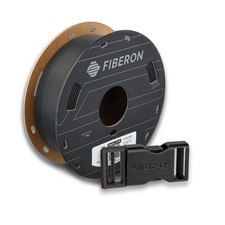
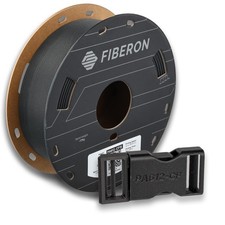
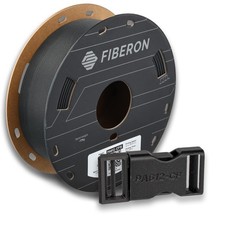
Fiberon PA612-CF15 is a 15 wt% carbon fiber reinforced long-chain PA612 nylon filament developed for rigid functional parts and engineering applications. It combines lower moisture sensitivity than PA6-based nylon with stronger mechanical performance than PA12-based materials, providing a practical balance of strength, dimensional stability, and moisture-conditioned performance. Typical TDS values include a dry X-Y tensile strength of 91.9 MPa and a Young’s modulus of 5.14 GPa. After annealing at 100°C for 16 hours and undergoing the specified moisture-conditioning process, the typical X-Y tensile strength is 83.1 MPa. The heat deflection temperature reaches 175°C at 0.45 MPa after annealing. These values are typical reference data; final-part performance may vary with part design, print orientation, settings, and operating conditions. Although PA612-CF15 is less moisture-sensitive than PA6-based nylon, it remains hygroscopic. Keep the filament below 20% relative humidity during storage and printing. If the material has been exposed to ambient humidity, dry it at 100°C for 10 hours before use. Proper moisture control helps reduce stringing, bubbles, rough surfaces, and inconsistent extrusion. Recommended settings include a 250–300°C nozzle, a 40–50°C build plate, an all-metal hotend, and the cooling fan turned off. A heated chamber is not required under the TDS conditions. Because carbon fiber is abrasive, use a hardened steel, ruby, or other wear-resistant nozzle. Before long prints, confirm that the filament path is smooth and the spool rotates freely. Fiberon PA612-CF15 uses the same formulation as the former PolyMide PA612-CF. The Fiberon version may produce a slightly darker black shade than the previous version. For improved heat performance and dimensional stability, anneal printed parts at 100°C for 16 hours.
15% Carbon Fiber Reinforced PA612: Fiberon PA612-CF15 is a long-chain PA612 nylon reinforced with 15 wt% carbon fiber. It combines lower moisture sensitivity than PA6-based nylon with stronger mechanical performance than PA12-based materials, making it suitable for rigid functional parts, tooling, jigs, fixtures, and engineering prototypes.
Strength Retention After Moisture Exposure: Typical TDS values include 91.9 MPa dry X-Y tensile strength and 83.1 MPa after the specified annealing and moisture-conditioning process. This balance makes the material useful for parts that may experience changing humidity during service.
Heat Performance After Annealing: The heat deflection temperature reaches 175°C at 0.45 MPa after annealing at 100°C for 16 hours. Annealing also helps improve dimensional stability. HDT is a standardized test value and should not be interpreted as the continuous operating temperature of every printed part.
Lower Moisture Sensitivity Still Requires Dry Storage: PA612-CF15 is less moisture-sensitive than PA6-based nylon but remains hygroscopic. Keep the filament below 20% relative humidity during storage and printing. Dry at 100°C for 10 hours before use if exposed to ambient humidity or if stringing, bubbles, or rough surfaces appear.
Advanced Printer and Wear-Resistant Nozzle Required: Use an all-metal hotend, a 250–300°C nozzle, a 40–50°C build plate, and a hardened steel or ruby nozzle with the cooling fan off. A heated chamber is not required under the TDS conditions. Speeds up to 300 mm/s may be possible with a tuned profile. Before long prints, confirm smooth filament routing and unrestricted spool rotation.