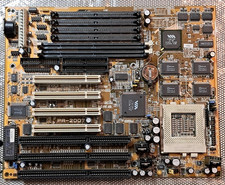
FICPA-2007 Motherboard
GreatVintage / Retro Socket-7 (Pentium) motherboard !
Thisspecimen recognizes AMD K6-2 CPUs, and has a 2.1V option!
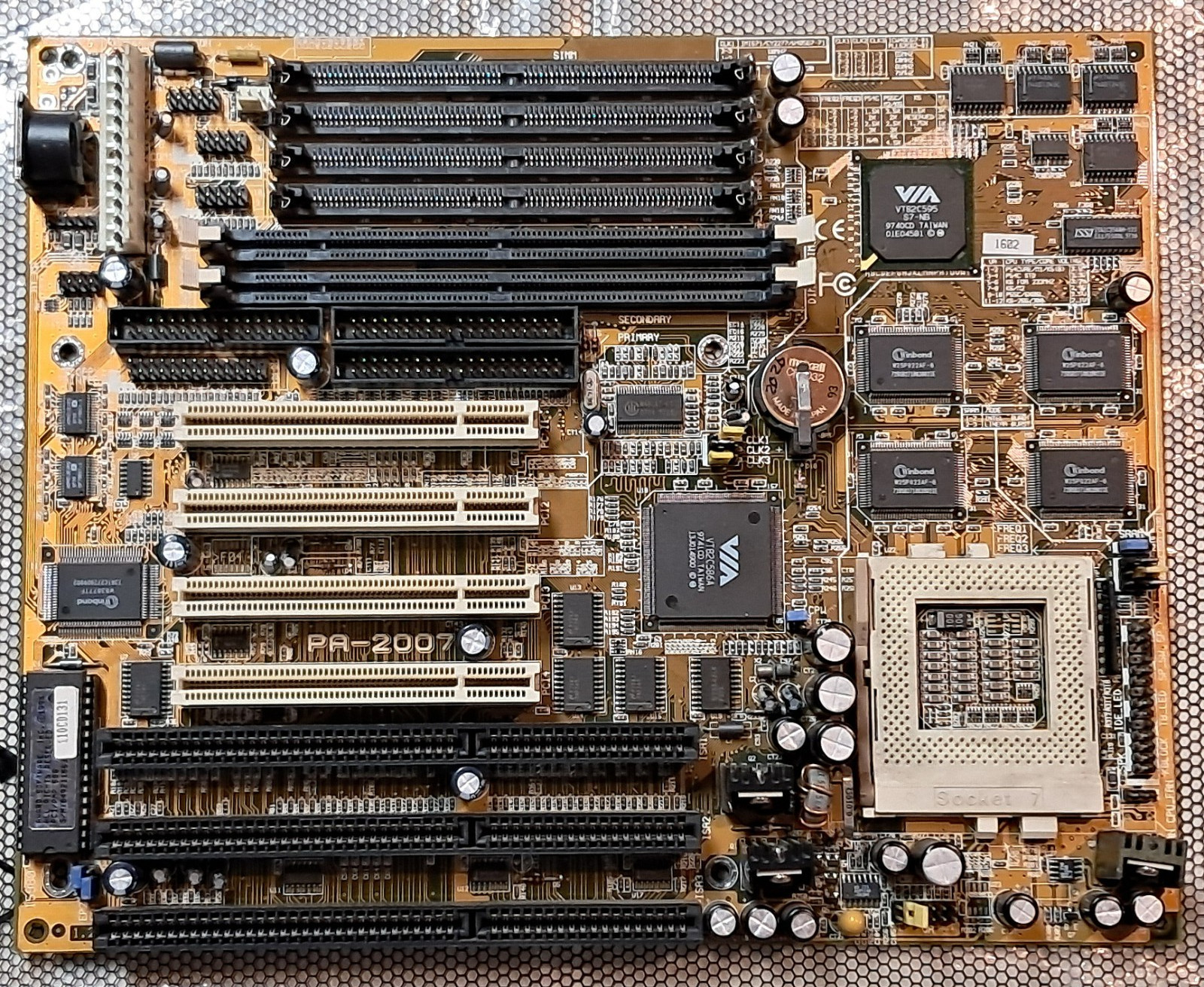
This Baby AT, Socket-7 motherboard is one of FIC’sfamous PA-2005, 2006, & 2007 series of boards. Nominally they were designed for Pentium 90to 233 MHz CPUs, the Cyrix/IBM PR110 to PR233 CPUs, and the AMD K5/K6 CPUs. But this particular board has anupdated BIOS and even recognizes the K6-2 CPUs.And I was surprised that this particular board revision added a 2.1V Vcoreoption, allowing the use of more CPUs than older PA-2007 boards.
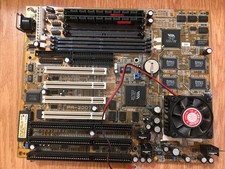
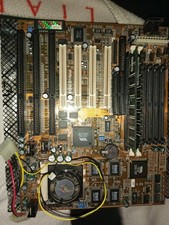
As far as I can test it, this motherboard is essentiallyperfect, with NO bulging caps or damage to traces, sockets, ports or otherelectrical components other than some trivial handling scratches. Ifound this board to be a real joy, but specifically forthis sale, I retested & verified every one of these board functions:
·AT Power Supply
·AT Keyboard port & PS/2 Mouse connector
·CPU Voltage changes
·FSB / CPU Frequency & Multiplierchanges
·All SIMM & DIMM Memory Slots
·All 3 ISA slots and 4 PCI Slots
·Both IDE Connectors
·Floppy Connector
·Both USB connectors
·Parallel/LPT1, and both COM Ports
·CPU Fan Connector
·LEDs for Power & IDE/HDD, the Speaker, and the Reset function
It accommodates either SIMM or DIMM memory,and has both ISA and PCI slots. It has afull 1 Mb of L2 cache, to speed up more of your programs and calculations. And its VIA VP2 chipset was a real innovationin its day.
[FullSpecs are listed at the end of this ad.]
Several critics of that era were praising theboard. For example, here is s quote fromTom’s Hardware website:
The new numberone amongst the Socket 7 boards is called PA-2007 and is manufactured by FIC .This board is using the VIA Apollo VP2 chipset (also known as Etel, PC Chips orAMD 640 chipset). It supports SDRAM and Ultra DMA, but its big advantage is the1 MB onboard level 2 cache, which is mainly responsible for its excellent Win95and especially NT performance.
And the Australian website, Redhill, said:
The PA-2007 wasthe fastest motherboard in the world for a long, long time, and it was stillamongst the very best even in the twilight of its career.
FIC and VIA havealways had very close connections — they are both owned by the giant FormosaPlastics combine — and FIC have often taken advantage of this to be first outwith new VIA-based products. The PA-2007 was no exception: it was the firstboard to feature the VIA Apollo 590 VP-2 chipset. Naturally, it supported allthe then-new features like SDRAM, ATA-33, and linear burst mode, and it camewith a full 1MB of cache RAM — a very significant factor indeed. They were notcheap, but this sort of quality never is.
But there are a couple of things you shouldnote:
Owner’s manual- When I bought this board I did not receivethe original printed manual; I’ve been using a digital manual I downloaded fromthe RetroWeb website. Unfortunately thiscopy is a Mess, containing both the Rev. A0 & Rev. A1 versions, and afew Addendums. And those different setsof info often contradict each other. ButI think I’ve gotten it straightened out, and will provide printed pages withwhat I believe is the ‘hardware info’ pertinent to this particular board.
CPU Vcore Options-When this model was first designed, the ‘lowpower’ CPUs were the Pentiums, running at 2.8 V. So most of the PA-2007s had only 3.5V, 3.3V,3.2V, 2.9V, & 2.8V settings. Butthis newer, Rev. 1.2, board added another set of jumper pins, giving a new2.1V option. Please be surethese voltages cover what you need.(Note: I was able to get my 2.2V K6-2 CPUs running on 2.1V for most (butnot all) of their speed range. And my2.8V Pentiums run great, with no heating issues, on 2.9V)
Variations in FSB and Multipliersettings- As I just mentioned, there is a lot of confusion aboutwhat info applies to this board, including the proper settings for the FSB and CPUMultiplier jumpers. Sometimes the jumpersettings I use give me exactly the FSB & Multiplier I ask for. Other times the board seems to adjust the FSBand Multiplier, but even so they often end up creating essentially the desirednet CPU speed. Not sure what is goingon, but I am always able to get my desired CPU speed, but it may require usingan ‘undocumented’ jumper setting. I’ll provide summaries of my experiences withseveral Pentium, K6-2, and a Cyrix CPU for your reference.
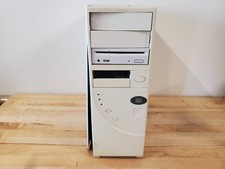
The Silver Lining with this is that thoseun-documented jumper settings may allow you to get much more performance outof your CPU. For example, I have runa Pentium 200 MMX at FSBs as high as 87.5 MHz, and at an overall speed of 263MHz. The system was rock steady even atstock voltage, and just ran Prime95’s Torture Testfor over 10 hours, performing many millions of calculations without any Errorsor even a Warning (see screen shot). Manyother tests and uses have also been without incident, whether using DIMM memoryor even old, slower SIMM memory.
Perhapsthe unexpected FSB & Multiplier values might be a result of its newer BIOS. And perhaps going back to the original BIOS mightresolve this. But I greatly preferredthe options for higher performance, so I never installed an older BIOS.
The Sale Includes:
- the FIC PA-2007 Motherboard, as described above
- A printed copy of most of the ‘hardware portion of the FICUser Manual
- a CD Disk, with a PDF version of the Owner’s Manual,a summary of my testing, and sometips & comments for reference.
I guarantee for 2 weeks after you receive theitems that the board performs as described above. I will ship them via insured, tracked USPSGround Advantage mail (usually faster than UPS Ground) within one business dayafter your payment, using packaging which protects everything from static &physical shock. Review my response and offer with confidence that everything is as Idescribe. Contact me if you have any questions.
FICPA-2007 Specs
·Form: Baby AT
·CPU support:6x86 to 166, 6x86MXto 233, C6, K5, K6, P54C, P55C.
·Speed:55, 60, 66, & 75MHz.
·Slots:4 PCI, 3 ISA
·RAM:(4) 72-pin FPM, EDO or BEDO,and (2) 168-pin SDRAM, up to 512MB.
·Cache:Surface mount, 1Mbpipeline burst
·Chipset:VIA Apollo 590VP2, AwardBIOS.
·Year of Release: 1997