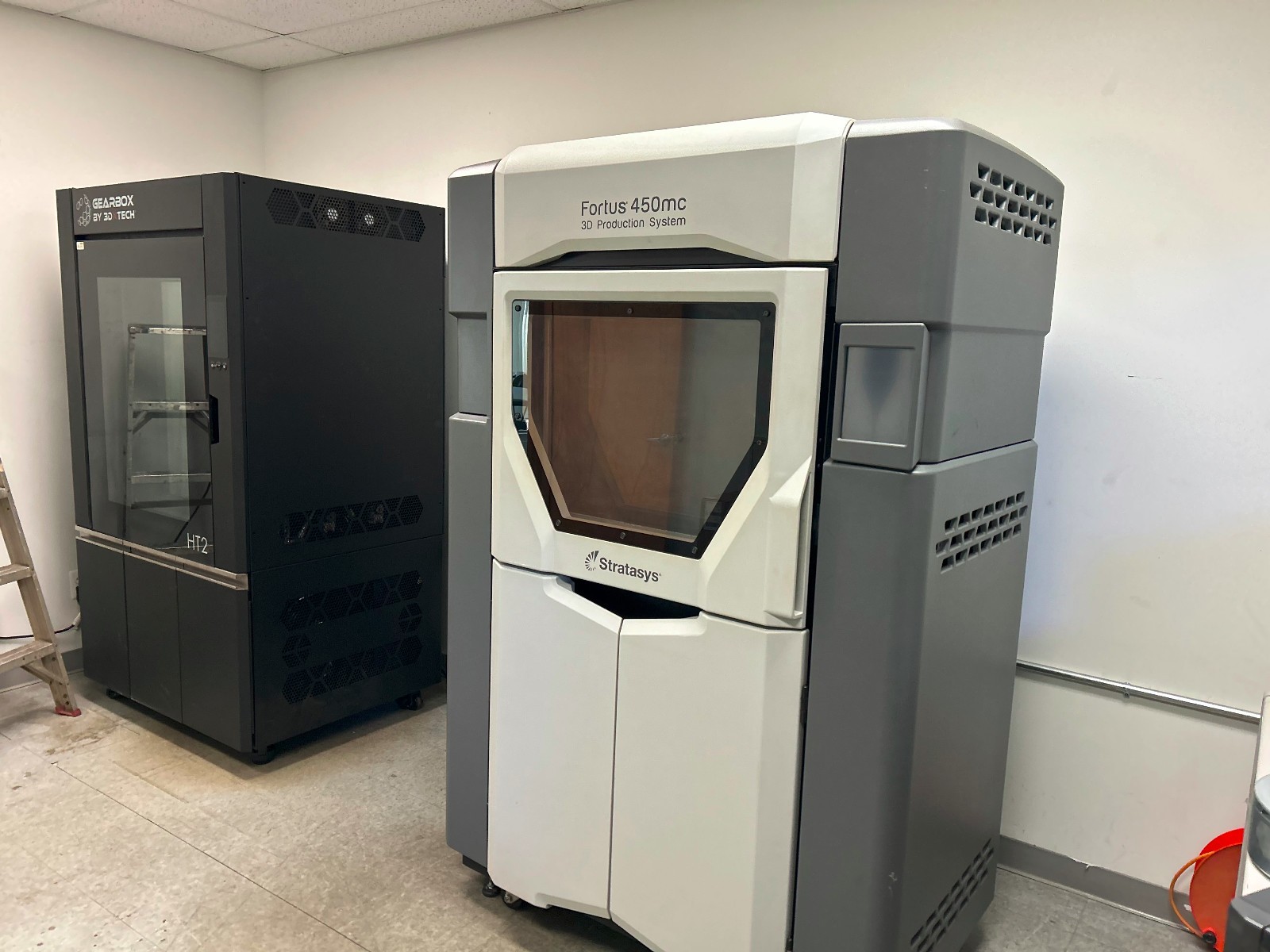
Key System Specifications
- Build Envelope (XYZ): 406 × 355 × 406 mm (16 × 14 × 16 in.)
- Build Volume: Approximately 58.5 liters
- Layer Thickness Options: 0.127 mm (0.005 in.), 0.178 mm (0.007 in.), 0.254 mm (0.010 in.), 0.330 mm (0.013 in.)(Some materials, like Nylon 12CF, may support up to 0.508 mm / 0.020 in. with specialized tips for faster builds.)
- Achievable Accuracy: ±0.127 mm (±0.005 in.) or ±0.0015 mm/mm (±0.0015 in/in), whichever is greater.Z-axis includes an additional tolerance of -0.000 / +slice height. (Accuracy is geometry-dependent; derived from statistical data at 95% dimensional yield.)
- Material Delivery: Two bays each for model and support canisters (four total). Auto changeover between canisters for uninterrupted printing.
- Support Materials: Soluble (e.g., SR-30, SR-100) or breakaway, depending on the model material.
- Network Connectivity: 10/100 base T Ethernet (TCP/IPv6 protocols).
- Software: Compatible with GrabCAD Print / GrabCAD Print Pro, Insight, and Control Center. OpenAM license available for expanded material options. Windows OS support (Windows 10/11 or Server).
- Operator Requirements: Limited attendance needed (job start/stop).
- Data Security: Supports Stratasys ProtectAM™ (including U.S. DoD STIG compliance options).
Physical Dimensions & Power
- System Size: 129.5 × 90.2 × 198.4 cm (51 × 35.5 × 78.1 in.)
- System Weight: 601 kg (1,325 lbs.)
- Power Requirements: 208 VAC, 3-phase, 50/60 Hz, 18 Amps.
- Regulatory Compliance: CE, cTUVus, and others (e.g., RCM, EAC, FCC Part B in some configs).
Materials
The Fortus 450mc supports a wide range of Stratasys Preferred Materials and Validated Materials (including engineering-grade and high-performance thermoplastics). It includes hardened components for carbon-fiber-filled materials (no extra kits needed in newer configs).
How Material Licensing Works on the Fortus 450mc
Stratasys offers materials in tiers/bundles:
- Standard — ABS-M30 family, ASA, etc.
- Engineering — PC, PC-ABS, PC-ISO, Nylon 12, etc.
- High Performance — ULTEM 9085, ULTEM 1010, ST-130, Antero, etc.
You can buy stand-alone licenses for individual materials (like ULTEM 1010) or upgrade to the All
Material License for this machine is ultem 1010
Here's a clear and detailed specification overview for ULTEM™ 1010 resin (polyetherimide / PEI), the high-performance FDM material you're running on your Fortus 450mc.
Key Features & Benefits
- Highest heat resistance of any FDM thermoplastic.
- Excellent tensile strength and rigidity.
- Superior chemical resistance (hydrocarbons, alcohols, aqueous solutions, etc.).
- Can withstand steam autoclaving.
- Biocompatible (ISO 10993 certified).
- Food contact certified (NSF 51).
- Inherent flame retardancy (passes multiple FAR 25.853 and UL tests).
- Low coefficient of thermal expansion → excellent dimensional stability for tooling and precision parts.
Color: Natural (translucent amber).
Support: Breakaway (typically SUP9000B or equivalent ULTEM support).
Mechanical Properties (Typical Values)
Properties are anisotropic due to FDM layer bonding. Values shown are for XZ orientation (strongest, on-edge) and ZX orientation (upright, weakest in Z).
PropertyTest MethodXZ OrientationZX OrientationTensile Strength, YieldASTM D63864 MPa (9,300 psi)41 MPa (5,990 psi)Tensile Strength, UltimateASTM D63881 MPa (11,700 psi)48 MPa (7,000 psi)Tensile ModulusASTM D6382,770 MPa (402,000 psi)2,200 MPa (322,000 psi)Tensile Elongation at BreakASTM D6383.3%2.0%Flexural StrengthASTM D790144 MPa (21,000 psi)77 MPa (11,100 psi)Flexural ModulusASTM D7902,820 MPa (409,000 psi)2,230 MPa (324,000 psi)Izod Impact, Notched (23°C)ASTM D25641 J/m (0.8 ft-lb/in)24 J/m (0.4 ft-lb/in)Izod Impact, Unnotched (23°C)ASTM D256326 J/m (6.1 ft-lb/in)138 J/m (2.6 ft-lb/in)Compressive Strength, YieldASTM D695134 MPa (19,500 psi)107 MPa (15,100 psi)
Note: Newer datasheets (e.g., for F900 with T14 tip) may show slightly different values (e.g., tensile ~79 MPa in XZ). Always refer to the exact datasheet matching your machine and tip configuration for production work.
Thermal Properties
- Heat Deflection Temperature (HDT) @ 66 psi (0.45 MPa): 216 °C (421 °F)
- HDT @ 264 psi (1.82 MPa): 213 °C (415 °F)
- Glass Transition Temperature (Tg): 215 °C (419 °F)
- Vicat Softening Temperature: 214 °C (416 °F)
- Coefficient of Thermal Expansion: ~47 μm/(m·°C) (XZ), lower in flow direction
This makes ULTEM 1010 one of the highest-temperature FDM materials available — suitable for under-hood automotive, aerospace out-of-cabin, and high-temp tooling.
Other Properties
- Specific Gravity: 1.27
- Rockwell Hardness: ~109
- Volume Resistivity: 1.0 × 10¹⁴ – 8.96 × 10¹⁵ ohm-cm
- Dielectric Strength: 240 V/mil
- Flame/Smoke: Passes FAR 25.853 (vertical burn, heat release, smoke density), Oxygen Index 0.44, UL 94 V0 rating in some tests.
Printing on Fortus 450mc
- Layer Thicknesses (typical for ULTEM 1010): 0.254 mm (0.010 in.) and 0.330 mm (0.013 in.) are most common; finer layers possible depending on tip.
- Requires high-temperature purge ledges (specific to ULTEM 1010 on the 450mc), high-temp build sheets, and dedicated tips.
- Chamber preheat and stabilization: Often 4+ hours when starting or switching to this material.
- The machine will check hardware compatibility and block printing if the wrong purge ledges or tips are installed.
Common Applications
- Aerospace: Ducting, brackets, interior/out-of-cabin components (where high heat and strength are needed).
- Automotive: Under-hood parts, high-temp fixtures.
- Medical/Food: Autoclavable tools, custom devices, food-production tooling (thanks to certifications).
- Industrial Tooling: High-temperature jigs, fixtures, composite layup tools.
Tip: ULTEM 1010 is stiffer and higher-temperature than ULTEM 9085 resin, but 9085 is generally tougher (better impact) and has stronger FST (flame/smoke/toxicity) ratings for aircraft interiors. If your license ever gets upgraded, 9085 is the most common next high-performance material.