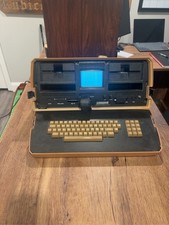
Appearance: UsedFunctionality: Untested
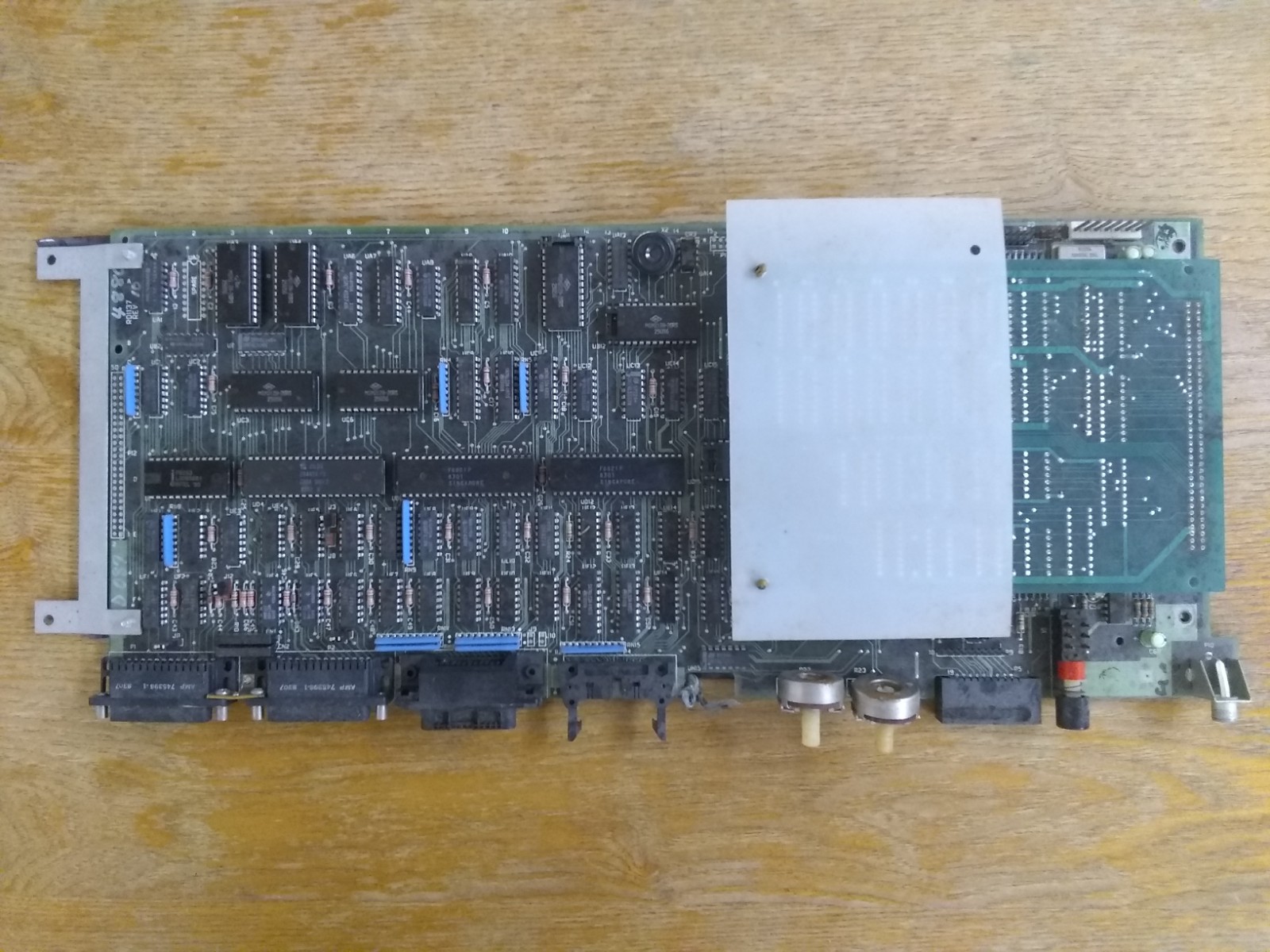
Description:============As pictured, an Osborne motherboard. Includes just the picture board – no other accessories are available.
*** We are unable to test this item. Please review the warranty and returns policy ***
Warranty and Returns:=====================This product is being sold AS-IS without any warranty. Returns are not accepted. To ensure that this is the right product for your needs, we’re happy to answer any questions.
Shipping:=========- Other shipping methods are available – contact us for details.- Combined shipping is available for most items – contact us for details.- Local pickup is also available at no cost.
About Us:=========The Computer Preservation Group is dedicated to the preservation of historical computers. To help fund ongoing operations, select items are made available. To learn more, please visit our website. Thank you for your from wikipedia:
Developer Adam OsborneType Portable computerRelease date April 3, 1981; 36 years agoIntroductory price US$1,795 (equivalent to $4,729 in 2016)Discontinued 1983Operating system CP/MCPU Zilog Z80 @ 4.0 MHzMemory 64 KB RAMSuccessor Osborne Executive
The Osborne 1 was the first commercially successful portable microcomputer, released on April 3, 1981, by Osborne Computer Corporation. It weighed 10.7 kg (24.5 lb), cost $1,795 US, and ran the CP/M 2.2 operating system. Powered directly from a mains socket as it had no on-board battery, it was still classed as a portable device since it could be packed away and transported by hand to another location.
The computer shipped with a large bundle of software that was almost equivalent in value to the machine itself, a practice adopted by other CP/M computer vendors at the time.
Competitors such as the Kaypro II that used double sided drives and larger 9" screens that could hold a full 80x25 display quickly model Osborne 1 with the redesigned caseThe 64 KB main memory was made of four rows of eight type 4116 dynamic RAM chips, each with 16,384 bits. Memory was shared between CPU memory and video memory, with 60 KB usable to software. No parity was provided and no provision for memory expansion existed on the motherboard. The boot program loader and significant parts of the BIOS were stored in a 4 kilobyte EPROM, which was bank-switched. A second EPROM was used as a fixed character generator, providing upper and lower case ASCII characters and graphic symbols; the character generator was not accessible to the CPU. The eighth bit of an ASCII character was used to select underlined characters. Serial communications was through a memory-mapped Motorola MC6850 Asynchronous Communications Interface Adapter (ACIA); a jumper on the motherboard allowed the MC6850 to be set for either 300 and 1200 baud or 600 and 2400 baud communications, but other bit rates were not available.[14]
The floppy disk drives were interfaced through a Fujitsu 8877 disk controller integrated circuit, a second-source of the Western Digital 1793. The parallel port was connected through a memory-mapped Motorola MC6821 Peripheral Interface Adapter (PIA) which allowed the port to be fully offerirectional; the Osborne manuals also claimed the port implemented the IEEE-488 interface bus but this was rarely used. The parallel port used a card-edge connector etched on the main board, exposed through a hole in the case; any IEEE-488 or printer cable had to be specially manufactured for the Osborne.[14]
The diskette drives installed in the Osborne 1 were Siemens FDD 100-5s (MPI drives were also used later), which were actually manufactured in California by GSI, a drive manufacturer that the German firm had purchased. They utilized a custom controller board that Osborne produced themselves, which among other things had a single connector for both the power and data lines. The FDD 100-5 proved to be quite trouble-prone as Osborne's quality control was lacking and many of the controller boards had soldering defects. In addition, the drive cable was not keyed and could be very easily installed upside-down, which would short out components in the computer and there were also problems with the drive head going past track 0 and getting stuck in place. The combo power/data cable also had a tendency of overheating.[14]
The video system used part of the main memory and TTL logic to provide video and sync to an internal 5-inch monochrome monitor. The same signals were provided on a card edge connector for an external monitor; both internal and external monitor displayed the same video format.[14]
The processor, memory, floppy controller, PIA, ACIA and EPROMs were interconnected with standard TTL devices.[14]